
22 years old · Character in Book 1
Machine Learning Engineer · models and tools
Leo Martín
He arrives at ATLAS with plenty of ideas and an eye on what others think of him.
Computer Science graduate, beginning a master’s degree in AI.
Leo is 22, has completed a degree in Computer Science and is starting a master’s in artificial intelligence. He joins ATLAS after passing a selection exercise that values both solving a problem and allowing someone else to repeat the work. For him, admission is a professional opportunity and a chance for people to get to know him before deciding he is the odd one.
He develops vision models and tools for experimentation. His agent uses a language model, an LLM, to write code and use tools from specifications: what a solution should do and how it will be checked. He keeps decisions so that work can resume across sessions. The idea excites him; making it useful to a team means listening to questions he cannot control.
- What they want
- To find his place and make a contribution he can defend.
- What is difficult
- Admitting a difficulty when he believes he should be able to handle everything.
- What they contribute
- Programming, curiosity and checks that preserve a memory of the work.
BACKGROUND AND FAMILY
Learning to find a place
As a child, he might answer too often or keep thinking about an idea when the class had moved on. Knowing things gave him a place, sometimes only until his next mistake. He learned to associate recognition with proving something, and to prepare answers for conversations that then went in a different direction.
His family loves him and trusts his abilities. His mother works in administration and his father maintains systems for a small business. When Leo says he is overwhelmed, he sometimes hears an encouraging “you can do it” and is left feeling he ought to manage alone. Help with his master’s and his room has a limit.
EVERYDAY LIFE
His room in the shared flat
He lives in a shared flat and has a modest computer. He likes automating things that perhaps did not need automating, returning to the same song again and again, and debating science-fiction endings. Walking along quiet streets lets him rest without having to explain why he needs to go alone.
Closing the door can bring relief. A little later, having nobody to tell something to can hurt. Rest becomes harder when he thinks he should be making better use of his time: he opens the laptop to fix one detail and finds he has turned the afternoon into another test.
DESIRE AND DEFENCE
Watching how people see him
He wants his contribution to be beyond question, but also wants someone to count on him for something other than work. He is impressed by people who seem to know what to say and when to leave. He compares himself with them before knowing what maintaining that confidence costs them.
When he feels watched, he can explain too much in an effort to recover ground. If he notices he has taken over, he swings the other way and thinks he ought to say nothing. His inner judgement is usually more absolute than what he manages to say. He can dismiss a conversation because he cannot find a way into it, then regret missing it.
CRAFT AND BLIND SPOTS
What he can do and what remains open
He connects concepts, writes code and spots assumptions others have taken for granted. In theatre he also remembers other people’s lines, though finding his cue and positioning his body are harder. He likes turning an imprecise intention into conditions that can be checked. Finishing a small task becomes difficult once he has imagined a more ambitious solution. He may promise before asking what resources or time it requires.
The record preserves context explicitly: what was requested, why an option was chosen and what was checked. Documenting a decision does not train the model on it. Its usefulness depends on another person understanding the record and on the starting conditions being right. Leo can document something wrong with great precision. That possibility touches a sensitive point: a correction to his work feels too much like a correction to his whole self.
VOICE AND GESTURES
The distance between thinking and speaking
With a technical problem, he strings conditions together and leans over the desk. In a personal conversation, he rehearses a short sentence, adjusts his glasses and sometimes raises his hands as if he needs to demonstrate that everything is fine. He can understand a feeling clearly without finding a way to share it.
When he stops trying to impress, he lets himself joke through a precise comparison or become excited about a small solution. Sometimes he is so concerned with getting things right that others take a while to discover that humour. He also gets bored, forgets things and wants to do something simply because he enjoys it.
CHARACTER AND EXPRESSION
How their expression changes.
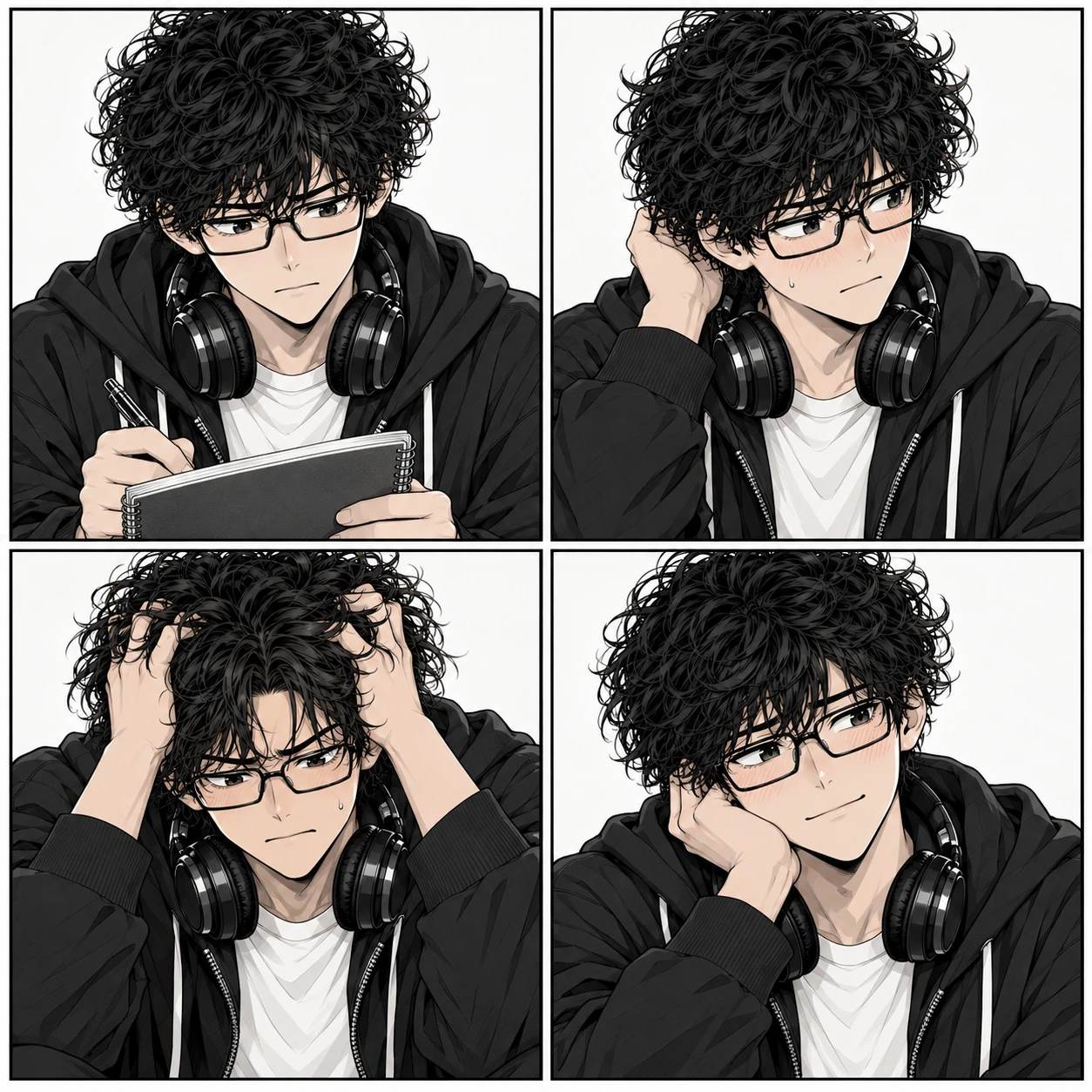
Four expressions of Leo. Read left to right, starting with the top row.
- Focus
His gaze settles and his shoulders draw around the notebook.
- Embarrassment
He reaches behind his head and avoids holding eye contact.
- Overload
He brings his hands to his head and his shoulders tense.
- Relief
A small smile appears as the tension leaves his shoulders.
TWO SIDES OF A RELATIONSHIP
Who shares their world.
Alicia and Leo
From Alicia
She can recognise a precise contribution while feeling crowded by how it is presented. Leo’s attention does not always arrive when she wants it. She wants him to hear the argument she is making, even when it conflicts with his preferred solution. She uses distance to regain space, with a coldness that can also hurt.
From Leo
He admires Alicia’s presence and judgement and tends to imagine her confidence extends to the rest of her life. He wants to be noticed and may interrupt to impress her when she needs to finish an explanation. He struggles to hear a technical objection without also measuring whether her opinion of him has improved or worsened. Fascination does not tell him what she feels.
Álvaro and Leo
From Álvaro
He finds a potentially interesting story in Leo’s enthusiasm. He can help formulate an idea while growing impatient with an explanation that does not fit his format. He prefers a memorable sentence; Leo may need another question. An interviewee’s trust tests his judgement about which fragment to keep.
From Leo
Álvaro’s ease impresses him, and recognition from him can make Leo feel chosen. He has work and ideas to explain, but attention can lead him to promise or share something before asking. He can confuse a conversation going well with being fully understood. Having room to finish an unglamorous explanation matters to him too.
Inés and Leo
From Inés
She sees judgement and potential in someone beginning to work with other people’s dependencies. His enthusiasm feels familiar. She can rely too much on that energy to compensate for a narrow margin. She needs to hear what Leo has achieved and where he is stuck; celebrating only brilliance also shapes what he will find hardest to tell her.
From Leo
Inés choosing him tells him that someone has noticed a concrete contribution. He looks for confirmation that he deserves his place and can hear an invitation to excel where there is a bounded task. He struggles to separate a limit on scope from a judgement of his worth. Asking for help exposes his fear of disappointing the person who opened the door.
Jun and Leo
From Jun
He appreciates a difficult question when it leads to a concrete check. Leo’s proposal interests him for the work it saves or improves, and he wants to see whether another person can run it. He can have the right objection and deliver it with superiority. Documentation looks like an easily inflated cost to him; impatience can stop him recognising what it does preserve.
From Leo
Jun’s experience brings out admiration and resistance. He wants to contribute something the existing tools do not already solve and can try to prove it before understanding how the team works. A direct question touches his proposal and his fear of being unnecessary. Accepting technical help becomes harder when he thinks the question is who knows more.
Leo and Mara
From Leo
With Mara he finds humour and a kind of listening that lets him relax. The closeness matters; they also work together on images, decisions and tests that do not always succeed. He can focus on solving something and stop seeing the time she gives. A sharp reply or a time limit can seem personal before he asks what is happening. Knowing one part of her life does not give him the rest.
From Mara
She enjoys his curiosity and a conversation that is not seeking an audience. She can share a technical idea or a joke and want to keep talking after the task ends. She also tires of his hurry to fix or prove something. Rapport needs room for her to explain a need, become angry or spend the afternoon elsewhere. Attention is not permanent availability.
Leo and Nadia
From Leo
He appreciates raising a technical doubt without it becoming a joke at his expense. He may seek confirmation of his disagreement with Jun when Nadia is trying to establish something else. One of her questions can force him to revisit an example he thought sufficient. Preparing an argument is easier than accepting there may be no time to review it today.
From Nadia
She appreciates a testable hypothesis and a well-prepared question. She needs to know the particular run before supporting a conclusion; a clear record helps without replacing a check of the assumption. She feels uneasy being made the referee of a rivalry. Her judgement and commitments still exist when Leo needs an answer.
Leo and Nico
From Leo
Nico’s ease in starting a plan offers company and brings comparison. He has enthusiasm to share, though he sometimes turns down an invitation because he does not know how to take part. At work he can overlook Nico’s knowledge because a fault seems small or practical. He wants inclusion without acting as the most sociable person and struggles to recognise when he needs someone else to teach him.
From Nico
He enjoys Leo’s intense interest and offers everyday company. He can also compare himself with talent that seems to attract recognition quickly. He knows things Leo still needs to learn and wants a practical question heard in full. An invitation leaves a door open; it does not remove his commitments or make him a permanent companion.
The biographies and relationships include the characters’ backgrounds; not all have been depicted in the story.
The places in their life.

Teamwork
ATLAS laboratory ↗
Leo arrives at a desk slightly apart; everyone else already has work to do.

Results and questions
Evaluation room ↗
Before accepting a score, there are a few questions to answer.

Private space
Leo’s room ↗
Here he reopens the laptop or thinks through what happened during the day.

University life
The campus between doors ↗
A conversation can start just as the other person needs to leave.