Shared resources
Server room
There is a queue here too, though nobody stands in it.
- Where we are
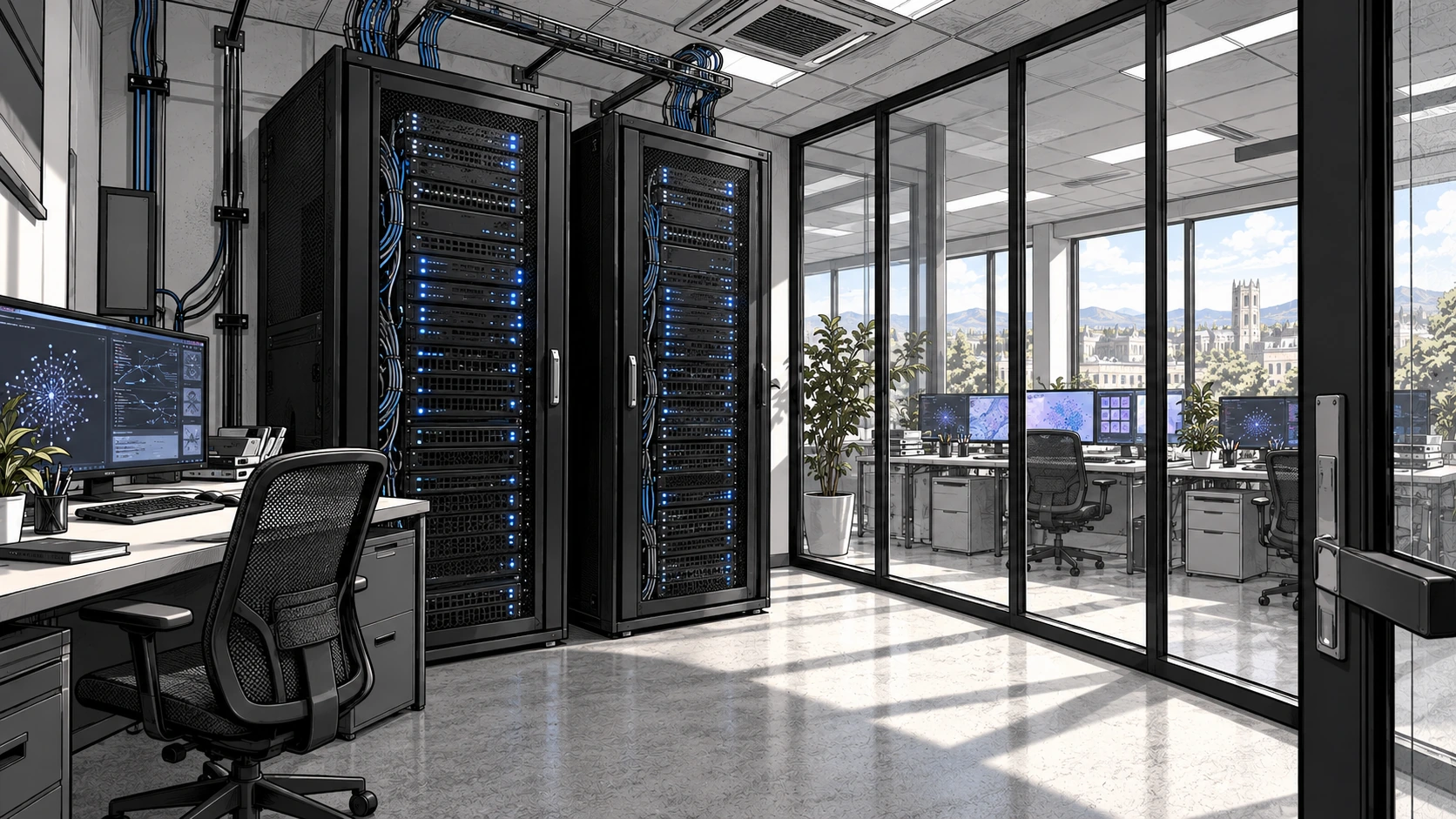
- At the north-west end of ATLAS, separated from the open area by glass.
- What it feels like
- Continuous ventilation, cool light and shorter conversations than at the desks.
The glass-fronted room at the back houses part of ATLAS’s local infrastructure. From the desks, it is clear that the equipment keeps working even when nobody has their hands on a keyboard. Jun keeps that work running; Nico and Mara need the services and data to be able to use it predictably.
What is here
- Enclosed racks and neatly arranged cables.
- An access-controlled door and discreet status lights.
- A small, uncluttered room, distinct from a large university data centre.
A sound that never rests
The glass makes the machines visible while keeping them separate from everyday work. Inside, the ventilation and equipment are louder than the laboratory conversations. Neat cables and a clear floor serve maintenance and movement, rather than creating an impressive room for visitors. A light indicates a state; by itself, it says little about how much work the equipment can take on.
The other half of a good idea
At ATLAS, vision models use time and memory on the shared GPU. Agents query language models through an API, the interface between programs; text sent and received is measured in tokens and uses the service allowance. The provider supplies the language model’s computation in this setup. Leo can use up that allowance and still edit local files. That does not free the GPU or entitle him to take another person’s booking.
That is why bookings affect people. Waiting for a run may push back a review, a departure or the shift of someone who already had another commitment afterwards.
Jun’s craft
Jun prepares the software and the conditions it needs to run, organises waiting jobs and keeps what is needed to repeat them. He also asks what will run and which resources it requires. He can clear a queue or explain a limitation; if two priorities compete, Inés decides what waits. Nico connects the services and Mara identifies the data versions. Saving a decision in a tool preserves context for later reference: it does not train a model by itself.
A door with a boundary
The door controls who enters the room; system permissions control which information they can use. Those are different kinds of access. Interviews about ATLAS are prepared elsewhere: a visit does not give access to working files or every screen someone encounters.
Who spends time here

MLOps · runs, resources and agents
Jun Park Etxeberria ↗
He wants the system to work and the working day to have an end.

Software Engineer · development and integration
Nico Serrano ↗
He likes fixing what fails and suggesting something to do afterwards.
Data Engineer · data preparation and lifecycle
Mara Quispe Salazar ↗
Between ATLAS, her master’s and the café, keeping an afternoon free is difficult.