
29 years old · Character in Book 1
Data Scientist · evaluation methodology
Nadia Vidal
She divides her working time between two projects and needs well-prepared questions.
Statistics degree and a doctorate in computational methods for biomedical research.
Nadia is 29, studied Statistics and holds a doctorate in computational methods for biomedical research. She is a postdoctoral researcher whose working time is shared between ATLAS and another campus project. Her role is to design comparisons and examine what supports a conclusion.
She is interested in the problem behind a number. She can help distinguish an improvement from a misleading clue, but needs to know the specific test. Her time with the team is limited, and she has work, choices and relationships beyond what the group asks of her.
- What they want
- Useful research and a career with continuity.
- What is difficult
- Accepting reasonable uncertainty without reviewing everything herself.
- What they contribute
- Evaluation design and judgement about what a result allows us to conclude.
BACKGROUND
A correction is part of a career too
She was born in Valencia. During her doctorate she found an evaluation error in work whose results she had already defended in public. Correcting it meant a difficult conversation and redoing part of the work. The experience showed her that putting something right could be part of continuing in research.
Since then, she asks how a result was reached before accepting the conclusion. She has already experienced the discomfort of correcting something she defended. That does not stop her becoming defensive when it concerns her: she can ask a rigorous question while also trying to protect work of her own.
TIME AND STABILITY
Two projects and a temporary contract
She devotes roughly forty per cent of her working time to ATLAS. Meetings, preparation and reviews must fit alongside the other project. Being close to the laboratory does not mean she has a whole afternoon to resolve a query nobody has narrowed down.
She wants a career with continuity and worries about moving between short contracts. Recognising other people’s work matters to her, but she fears being left maintaining corrections that are then credited to someone else. An invitation to collaborate can be an opportunity and a burden at the same time.
EVERYDAY LIFE
Singing without having to be the best
She has a partner outside research and friends in an amateur choir. She enjoys rehearsing a song, sharing a conversation that is not about results and growing tomatoes in pots with fairly uneven success.
She may arrive in a hurry because she wants to get to a rehearsal, or extend a review and become annoyed with herself for doing it again. She likes singing and seeing people who will not ask about the next result. Accepting a late review can cost her that time too.
CRAFT AND CONTRADICTION
From the example to the question
She uses two examples and a comparison when that is enough to explain the problem. She wants a decision to be tested on examples separate from those used to choose it. She looks for an observation that would distinguish a suspicion from a conclusion, and enjoys it when someone improves the question. In biomedical research she works with computational methods; she does not diagnose patients. A match between images raises a privacy question without, by itself, revealing a name or a disease.
Her caution has a blind spot too: she can demand certainty that paralyses a reasonable decision. Sometimes she assumes the file being executed is the one she reviewed, or accepts too many tasks to keep a share of the credit. A rigorous argument does not make her immune to coordination problems.
RELATIONSHIPS
Colleague, reviewer and teammate
She and Inés share years of familiarity and a real difference in contractual power. She respects Jun’s ability to execute a test and debates how much time an incomplete review can save. Alicia brings a way of communicating that can produce pride and comparison at once.
Mara lets her follow the path of the data; Nico asks practical questions that can undo an elegant assumption. For Leo, she is someone to discuss technical questions with, who has commitments and standards of her own. She appreciates a prepared query and feels uneasy when someone wants confirmation of a disagreement with another person.
VOICE AND GESTURES
The pause before answering
She asks slowly and lets a quiet humour into a review. When tired, she takes off her glasses and delays putting them back on. If a discussion interests her, she draws arrows and listens to the end of the reply. Frustration tightens her mouth: her patience has a visible limit too.
CHARACTER AND EXPRESSION
How their expression changes.
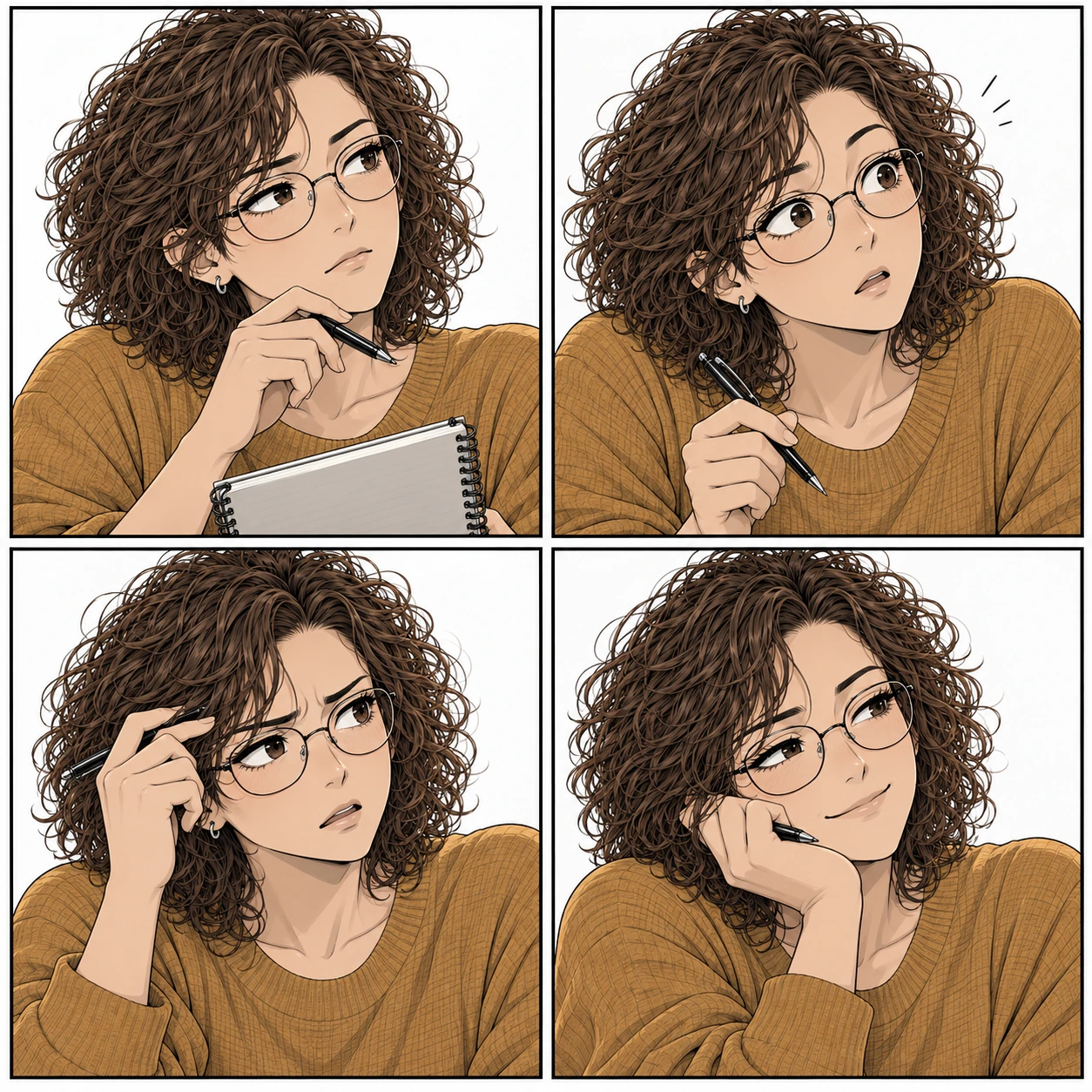
Four expressions of Nadia. Read left to right, starting with the top row.
- Analysis
Her pen pauses as she listens for what remains unexplained.
- Curiosity
Her eyes widen, eyebrows rise and lips part.
- Concern
Her expression grows serious before she voices an objection.
- Dry humour
A restrained smile accompanies brighter eyes.
TWO SIDES OF A RELATIONSHIP
Who shares their world.
Alicia and Nadia
From Alicia
In Nadia she finds methodological experience and someone who takes a question further. She wants to learn without being fixed in the role of pupil. Preparing an evaluation together means recognising what each proposed and what they still do not know. Her ease in presenting an idea can obscure who helped build it.
From Nadia
She values Alicia’s judgement and communication. Seeing one of her own questions delivered more effectively through Alicia can bring pride and comparison. She needs the exchange to allow room for her judgement and review time. Greater experience in one area does not make Alicia’s perspective on another dispensable.
Inés and Nadia
From Inés
She trusts Nadia’s judgement and can assume a review is available precisely because she knows its reviewer. Their shared history does not remove her colleague’s professional needs. She would like to keep that experience, but must answer with what she can actually offer. Affection sits alongside decisions that affect them differently.
From Nadia
She values years of shared work and trust that makes debate easier. Her contract and opportunities differ from Inés’s. She wants to disagree without closeness making it harder to ask for time, credit or clear conditions. Knowing each other well can save an explanation and can also mean a need of her own is assumed to be settled too soon.
Jun and Nadia
From Jun
He respects a review that distinguishes what has been checked and enjoys discussing problems with someone who knows their starting point. He can experience an objection as erasing the effort of running the test. Nadia’s part-time commitment reminds him that a ready test does not guarantee an available conclusion. His next step also depends on the question they agree.
From Nadia
She needs the runs Jun makes possible and appreciates their repeatability. She wants to know whether examples used to choose an adjustment have been kept separate from those used to test it. He may see work ready to run where she still sees a poorly framed comparison. Disagreement can produce a better check or a struggle over who may delay the group.
Leo and Nadia
From Leo
He appreciates raising a technical doubt without it becoming a joke at his expense. He may seek confirmation of his disagreement with Jun when Nadia is trying to establish something else. One of her questions can force him to revisit an example he thought sufficient. Preparing an argument is easier than accepting there may be no time to review it today.
From Nadia
She appreciates a testable hypothesis and a well-prepared question. She needs to know the particular run before supporting a conclusion; a clear record helps without replacing a check of the assumption. She feels uneasy being made the referee of a rivalry. Her judgement and commitments still exist when Leo needs an answer.
Mara and Nadia
From Mara
She appreciates Nadia seeing scientific substance in data decisions that can look like administration. She lets her follow a transformation and hopes a review considers the time needed to change and repeat it. She may feel examined when she needed to discuss workload. Wanting a defensible test does not mean they can both give it the same hours.
From Nadia
She trusts Mara’s traceability and needs to know how a version was reached. A preparation decision can change what a model seems to demonstrate. From the reviewer’s position she may see a necessary change before the hours required to repeat it. Recognition matters to her, though visibility does not automatically fix her colleague’s schedule.
The biographies and relationships include the characters’ backgrounds; not all have been depicted in the story.
The places in their life.

Teamwork
ATLAS laboratory ↗
Leo arrives at a desk slightly apart; everyone else already has work to do.

Results and questions
Evaluation room ↗
Before accepting a score, there are a few questions to answer.

University life
The campus between doors ↗
A conversation can start just as the other person needs to leave.