
50 years old · Character in Book 1
Scientific direction and laboratory leadership
Inés Valdés
Funding, deadlines and priorities all end up on her desk.
Computer Science and a doctorate in machine learning.
Inés is around fifty, a computer engineer with a doctorate in machine learning. She leads ATLAS, answers for its funding agreements and sets priorities. She retains technical judgement and relies on people whose specialisms she can no longer handle individually.
She has chosen a complementary team and wants it to produce defensible research and opportunities for continuity. Decisions she sees as protecting it can increase the pressure on those with less room to manoeuvre. Leadership also makes her look at that difference.
- What they want
- To sustain the research and the people who put their faith in ATLAS.
- What is difficult
- Reducing a promise when she fears losing the whole opportunity.
- What they contribute
- Leadership, experience and responsibility for priorities and resources.
BACKGROUND AND EXPERIENCE
Learning to ask for resources
She was the first person in her family to complete a doctorate. She went through years of contracts and learned to present work and uncertainty in terms an institution could understand. She knows what a poorly explained evaluation can cost, even when a project is useful.
Valuable work that was reduced after poor communication made her particularly careful with presentations. Preparation gives her confidence; under pressure, it can become a need to control every slide. She knows the enthusiasm of someone starting out, and the price of promising more than will fit.
INTERESTS AND CARE
The life that also asks for her time
She likes swimming early, listening to music without working at the same time, and cooking for friends who prefer to discuss other things over dinner. She has people to care for and commitments that an extended working day can displace too.
She can switch off for an afternoon and still turn a decision over in her mind. Sometimes she postpones rest because she believes the team needs her, then organises everyone else’s day with the same demands. She can be warm and joke when welcoming someone; when tired, listening to a long explanation becomes harder.
DESIRE AND RESPONSIBILITY
A project and the people sustaining it
She wants useful evidence and sustainable research jobs. She worries about losing resources and leaving the people who trusted the project without continuity. Funding needs clear objectives, limits and an honest account of what has been achieved.
She can frame a narrow margin as a challenge the group will solve through organisation. The sentence expresses trust and can also conceal a shortage of hours. She does not always see soon enough that a reliable person is absorbing the cost of the plan. A possible contract matters to her precisely because she knows it affects a life beyond the meeting.
ABILITY AND BLIND SPOTS
Deciding what to leave out
She breaks down objectives, asks what can be demonstrated and recognises contributions that do not stand out in a graph. She must choose what to postpone when time or resources run short, and explain that decision to the people doing the work and those funding it. She has enough technical judgement to ask how a new proposal works without needing to be its leading specialist. Relying on the team helps her decide; it also means listening when they say something is unsupported.
Her blind spot appears when she defends the team’s independence while checking every step, or asks for openness and receives bad news poorly. She can assign coordination responsibility without sufficient authority. Having faced similar difficulties does not guarantee she understands the specific burden of the person in front of her.
RELATIONSHIPS AND POWER
The people Inés relies on
Jun brings the ability to resolve problems, Nadia methodological judgement, and Alicia a combination of analysis and coordination. Mara makes the work’s path visible, while Nico sustains tools that must function beyond the presentation. Leo brings enthusiasm and questions that can be useful and out of scope at the same time.
She trusts Jun to resolve an emergency and Mara to prepare a submission. That very trust can lead her to ask for the next effort without checking its cost to them. Recognising that she is exhausting the people she relies on to preserve the project is difficult.
VOICE AND PRESENCE
Firmness in small gestures
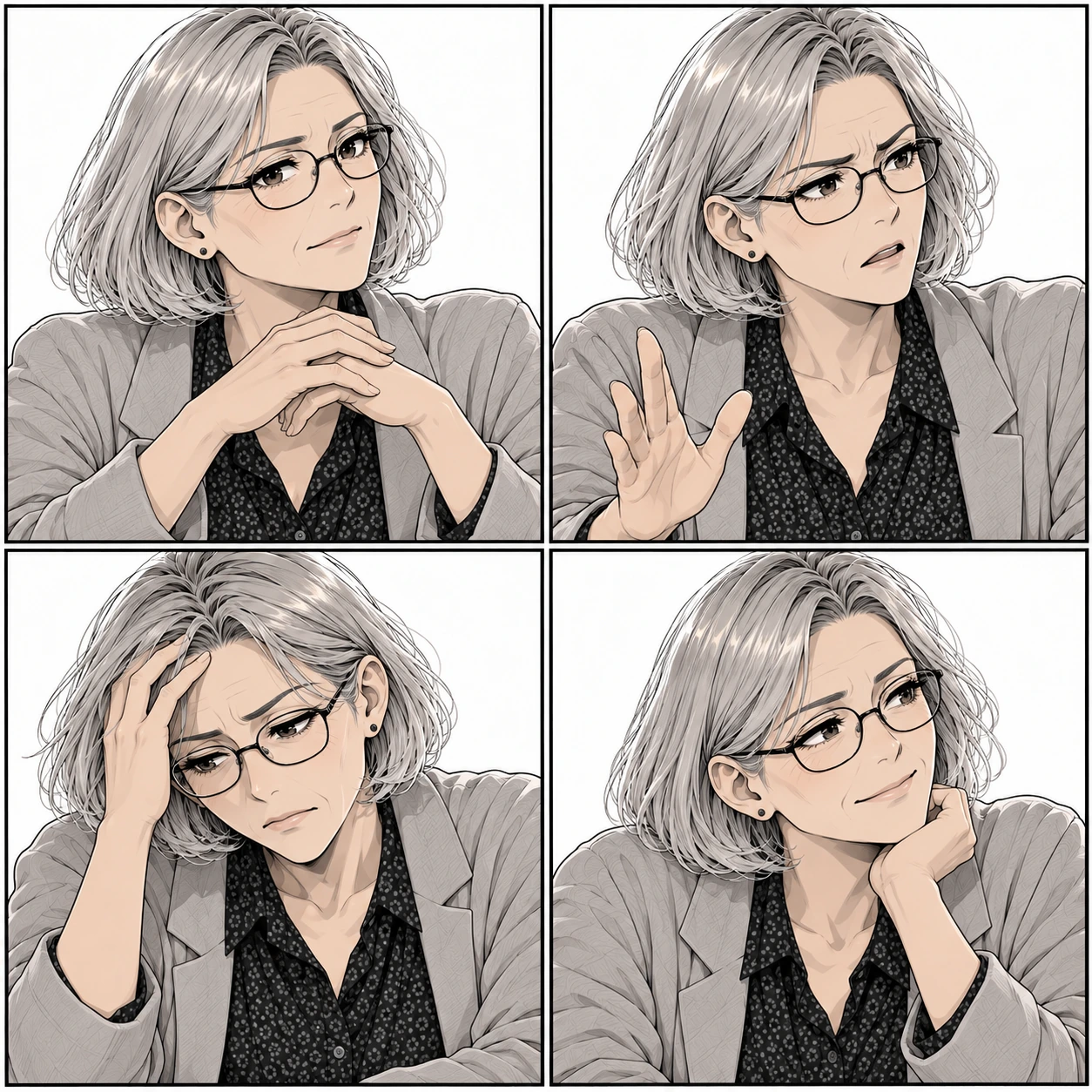
She speaks clearly and pauses before asking for a choice. When displeased, she may remove her glasses or tighten her jaw. Her humour is brief and responsive to the moment, without turning every boundary into a smile. She looks for concrete answers, though she may need time herself to recognise that a decision of her own must change.
CHARACTER AND EXPRESSION
How their expression changes.
Four expressions of Inés. Read left to right, starting with the top row.
- Calm authority
Her hands and gaze hold the conversation without rushing it.
- Disapproval
Her expression firms and her hand makes her point concrete.
- Pressure
Tiredness shows around her eyes and in the hand reaching towards her temple.
- Warmth
A brief smile reveals the humour beneath her responsibility.
TWO SIDES OF A RELATIONSHIP
Who shares their world.
Alicia and Inés
From Alicia
Inés’s trust gives her visible responsibility and a chance to demonstrate independence. She wants her analysis to count in a discussion of results, including with more experienced colleagues. She needs room to coordinate and clarity about what she can decide; outward confidence can make it too easy to assign her a task without discussing those conditions.
From Inés
She values Alicia’s analysis and ability to make a presentation understandable. She relies on her to bring different parts of the work together on time and keep their claims consistent. She can assign responsibility faster than authority, or mistake a confident explanation for a lack of need for support. Trusting Alicia also means hearing the objections she brings.
Inés and Jun
From Inés
She relies on technical ability she knows and needs. Jun’s speed can hide the work behind a fix or make her downplay his bluntness. Delegating frees her for other decisions; resolving conflicting priorities remains her responsibility. Trust requires Jun to be able to say what will not fit without proving it through another night of emergencies.
From Jun
He values the independence Inés gives him and a clear place for his ability to solve problems. He needs priorities when tasks compete for the same machine or his time. He can mistake trust for permission to set them alone. He does not want to answer for other people’s promises and sometimes expresses that fear as impatience with a request.
Inés and Leo
From Inés
She sees judgement and potential in someone beginning to work with other people’s dependencies. His enthusiasm feels familiar. She can rely too much on that energy to compensate for a narrow margin. She needs to hear what Leo has achieved and where he is stuck; celebrating only brilliance also shapes what he will find hardest to tell her.
From Leo
Inés choosing him tells him that someone has noticed a concrete contribution. He looks for confirmation that he deserves his place and can hear an invitation to excel where there is a bounded task. He struggles to separate a limit on scope from a judgement of his worth. Asking for help exposes his fear of disappointing the person who opened the door.
Inés and Mara
From Inés
She knows Mara delivers and can take a lack of protest as evidence the plan will fit. She needs Mara’s technical judgement as well as completed work. When a limit emerges, she must change scope, hours or responsibility. She can understand the problem and still be slow to remove work: a deadline does not vanish because Mara’s need is reasonable.
From Mara
Inés’s trust offers an opportunity and can make admitting a task will not fit harder. She wants her judgement about data and the time it needs to count. She also studies and works in the café; the prospect of continuing matters beyond the laboratory. She needs conditions she can take to those other commitments as well as words of confidence.
Inés and Nadia
From Inés
She trusts Nadia’s judgement and can assume a review is available precisely because she knows its reviewer. Their shared history does not remove her colleague’s professional needs. She would like to keep that experience, but must answer with what she can actually offer. Affection sits alongside decisions that affect them differently.
From Nadia
She values years of shared work and trust that makes debate easier. Her contract and opportunities differ from Inés’s. She wants to disagree without closeness making it harder to ask for time, credit or clear conditions. Knowing each other well can save an explanation and can also mean a need of her own is assumed to be settled too soon.
Inés and Nico
From Inés
She needs maintainable tools and knows Nico brings a different perspective from model research. Urgency can make a discovery more visible than the service supporting it. Recognising his contribution means allowing time for tests, handovers and faults. Asking him to help also displaces something he was going to do.
From Nico
He wants a place where practical experience counts and can support a stable life. He needs Inés to see maintenance alongside new developments. He knows a tool can still need work after a presentation. He may fill that gap to feel necessary and later struggle to explain that he cannot keep covering it.
The biographies and relationships include the characters’ backgrounds; not all have been depicted in the story.
The places in their life.

Teamwork
ATLAS laboratory ↗
Leo arrives at a desk slightly apart; everyone else already has work to do.

Decisions
Inés’s office ↗
Closing the door makes room for things that are hard to say in front of the team.

Results and questions
Evaluation room ↗
Before accepting a score, there are a few questions to answer.

University life
The campus between doors ↗
A conversation can start just as the other person needs to leave.