Eight tensions running through work, friendship and life outside the laboratory.
Talent and belonging
Leo has joined the team. Now he has to work without treating every conversation as a test of whether he deserves to stay.
When someone questions a proposal, Leo may hear more than a technical doubt: perhaps they are discovering that choosing him was a mistake. He then explains too much, tries to solve everything or falls silent. It helps to notice what he was asked and what he believes he is being told. They are often different things.
ATLAS needs modelling, data, services, evaluation and communication. If Leo only values the brilliant idea, he will struggle to understand what Nico or Mara contributes, and to accept that today he may need their help. Asking a question in time or correcting an error that somebody else can then avoid also contributes to that work.
A score and its conditions
The score improves. Before celebrating, Alicia and Nadia want to know what was compared.
A score can rise because a model works better, but also because we changed the images or chose a setting using the same examples on which we later measured it. Alicia and Nadia ask about those conditions. Jun knows the run and Mara knows the data preparation: answering means bringing their knowledge together.
Everyone wants to move forward and has a deadline. The argument concerns whether they can already defend an improvement or need to repeat a comparison. Repeating it takes a computing slot and review time. That is why it matters to explain which doubt it will resolve before asking for another test; demanding rigour without being specific can hold up the team too.
The cost of being available
Mara is asked for another review. Where in her day will it fit?
Mara has coursework and shifts. Nico must allow for travel, and Nadia divides her working time between two projects. Asking for another afternoon means moving something already arranged. To the person waiting for a result, it can seem minor; the person accepting has to decide what to put off.
The next question is what the team can change: reduce the task, share it, postpone something else or accept that it will not fit today. Appreciating the effort is welcome, but Mara still has the same number of hours. The story lets us see who makes that calculation and who only discovers the cost once the time has been spent.
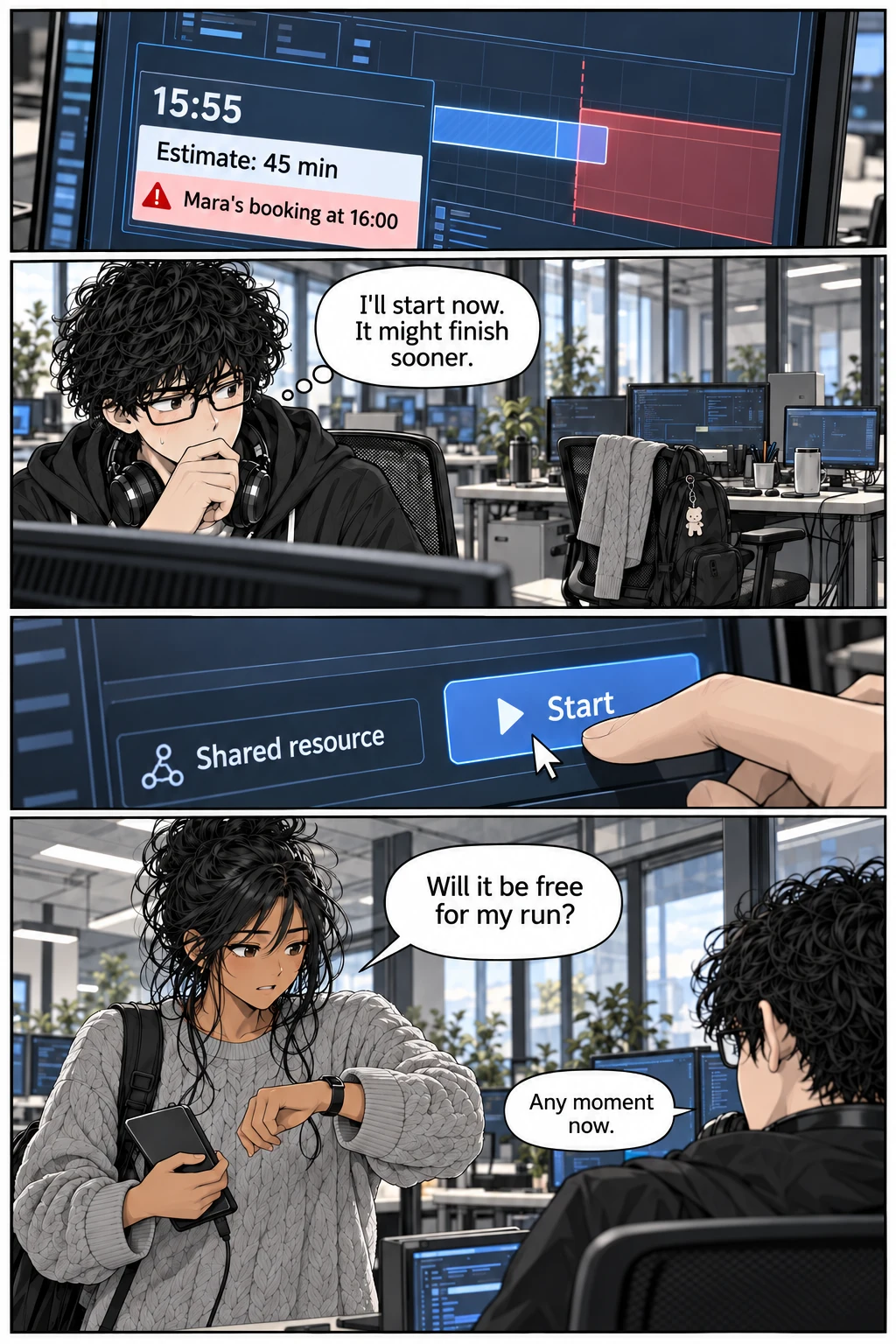
The screen already shows the clash. Leo starts the run and takes up part of Mara’s booked time.
Tools, trust and responsibility
Jun gets a task to run. Leo wants a record of what was requested and how it was checked.
Jun works with agents that write code and use tools. Leo proposes preserving specifications, decisions and tests so the work can be resumed. Both approaches can help. Trouble comes when an objection to the method becomes a competition between them and admitting that the original instruction was poorly framed becomes difficult.
Consider a run that finishes without errors. Someone still needs to check whether it received the right data, answers the question and leaves a service Nico can maintain. Mara and Nadia need to review other parts of that process. Automation can save work; knowing how much means counting these tasks too.
What is shown and what is lived
Alicia looks confident in front of a room. Leo knows much less about what happens afterwards.
Alicia presents confidently, and Álvaro can give an interview pace. Leo notices that ease and tends to use it to fill in the rest of their lives. Yet a presentation lasts a few minutes, and a recorded conversation is edited. Worries and disagreements remain outside what he sees.
Readers sometimes know about a pressure Leo is unaware of. That helps explain why a reply seems cold to him, or why Álvaro redirects an explanation that has been running long. We can follow those differences without automatically taking a side: a person may have an understandable reason and still hurt someone through their response.
Leading under pressure
Inés knows what the team can do. Judging how much more she can ask of it is harder.
Inés must fit objectives to the available funding, machines and working hours. Mara usually delivers, Jun resolves emergencies and Nadia finds a gap for a review. It is easy to build the next plan around them doing it again. The workload becomes apparent when someone explains what they are leaving out to meet it.
Inés then has to choose what to reduce or postpone and explain it to those expecting the work. Understanding someone’s exhaustion does not complete that decision. She may also need to revise a promise of her own, face an uncomfortable conversation or recognise that she assigned responsibility without enough room to carry it.
Closeness, desire and limits
Leo enjoys Mara’s company, notices Alicia and does not always understand what either wants from the encounter.
Leo can be talking to Mara while seeking someone else’s attention. Nico may offer help while hoping for closeness he has not asked for. Alicia can enjoy someone’s company and still need distance at another moment. It helps to follow what each expects and what they actually know about the other person’s wishes.
An offer of help or an invitation can mean different things to the person making it and the person receiving it. Leo needs to understand what others want once work or rehearsal ends. Knowing he is useful does not tell him whether someone wants to spend time with him. The story pauses over those conversations: who asks, who assumes and how each responds when the other person wants space.
A life beyond the next test
Leo opens the laptop to fix one detail and the afternoon slips away.
His room gives him quiet and freedom to follow an idea. He can also prolong an experiment, delay dinner or go to bed later than planned. The reflections on Leo address attention during monotonous tasks, hyperactivity that can exhaust him and responsibilities he keeps putting off. Outside the laboratory he discovers that remembering a script easily can coexist with needing help to move, listen or pace his effort.
The guidance book helps him ask questions he then has to fit into an ordinary day. When does he stop? Which activity does he keep when pressure returns? We can watch whether he follows an intention, drops it or tries again. That explains his progress better than treating the problem as solved when he writes down a good intention.