
22 years old · Character in Book 1
Data Engineer · data preparation and lifecycle
Mara Quispe Salazar
Between ATLAS, her master’s and the café, keeping an afternoon free is difficult.
A degree in Computer Science; continuing her studies at master’s level.
Mara is 22, was born in Madrid and has completed a degree in Computer Science. She continues studying alongside her work. Her parents, Laura Salazar and Diego Quispe, came from Arequipa before she was born. Their family history lives in her habits, humour and La Segunda Taza, the café and bakery where she helps alongside her work at ATLAS.
In the laboratory she handles data engineering and the delivery lifecycle: where each file comes from, how it is transformed and which version is being compared. She writes code and automates processes. Her work gives somebody else’s result a history that can be followed.
- What they want
- To choose an opportunity and have time of her own.
- What is difficult
- Asking for room without turning what she has received into an endless debt.
- What they contribute
- Traceable data, automation and care for a shared process.
EDUCATION AND CRAFT
Choosing computing through something close to home
She enjoyed building a simple application to organise orders for the business. Finding a useful answer to a concrete need mattered more to her than showing off a tool. During her degree she liked databases, testing and systems, alongside the modelling problems that attracted more attention.
She is used to asking what happened before and who will need to repeat it later. Preparing images also means deciding what survives cropping or resizing: information can disappear before it reaches the model. She writes those transformations, compares them and checks their effects. When someone reduces her contribution to organising files, she hears part of the work being erased. She usually explains the difference with a practical example and a dry joke.
FAMILY BACKGROUND
The family and the business
La Segunda Taza holds years of saving, changes of premises, negotiated rents and learning a trade. Diego works on the baking and production; Laura handles the till, purchasing and organisation. They swap tasks, laugh, argue and need rest. Mara knows the other side of a table that means free time to a customer.
Her studies cost all three of them time and money. She appreciates that support and sometimes turns it into an endless debt. The family can want her to take an opportunity and need her on the same shift. Mara also complains, arrives late or assumes her mother will remember an errand; at home, they love one another and also get on each other’s nerves.
TIME AND MONEY
The price of a free afternoon
She combines paid, limited hours in the laboratory with agreed café shifts and her master’s studies. Enrolment costs money and coursework needs time; taking fewer modules can delay completion. A favour that looks small from ATLAS can occupy the gap she had kept for an assignment, sleep or seeing someone. Wanting to make the most of an opportunity does not mean she can fit every working day into her own.
Sometimes she rules herself out of a plan before asking what it costs. She says she has a shift when she is also worried about not affording it or not wanting someone else to pay. She can see Alicia as fortunate without knowing what weighs on her. Pride protects Mara’s independence and sometimes prevents her from explaining what she needs.
PLEASURE AND A LIFE OF HER OWN
What she does after a shift
She likes walking without a destination, drawing building façades and dancing without waiting for someone to organise the perfect outing. She tries absurd flavours with her father and keeps friends from school and cousins with different projects. She can enjoy an afternoon without every conversation being about how hard she works.
She wants company and would like to choose whom she spends an afternoon with. Sometimes cost or timing makes her turn down a plan she would have enjoyed. When someone offers help, she can accept without wanting a closer relationship; saying so is difficult if she fears sounding ungrateful.
STRENGTH AND CONTRADICTION
Reliable until everything depends on her
She thinks about transformations and the person who will have to repeat them. That care lets her notice a problem hidden among the final results. She can also hold too much control, repair an error in silence and end up maintaining a dependency nobody else knows how to handle.
She finds it hard to say early enough that a task will not fit. She may accept it to avoid seeming uncommitted and then resent how invisible the sacrifice has been. She understands the value of automation; urgency can tempt her to fix something manually and trust herself to remember it later. What she demands of others sits alongside that vulnerability of her own.
VOICE AND BOUNDARIES
Listening to her tone
Mara usually clarifies with a question and finds humour in a concrete detail. When angry, she stops smiling and speaks more slowly; putting a hand on the desk lets her stop solving another task while she argues. Tiredness shortens her patience and can make a reply sharper than she intended.
With Leo she shares curiosity, jokes and arguments. With Nico she has an earlier familiarity that sometimes makes asking a favour easier and refusing one harder. Because Mara often notices what others need, they can be slow to realise that she needs something too.
CHARACTER AND EXPRESSION
How their expression changes.
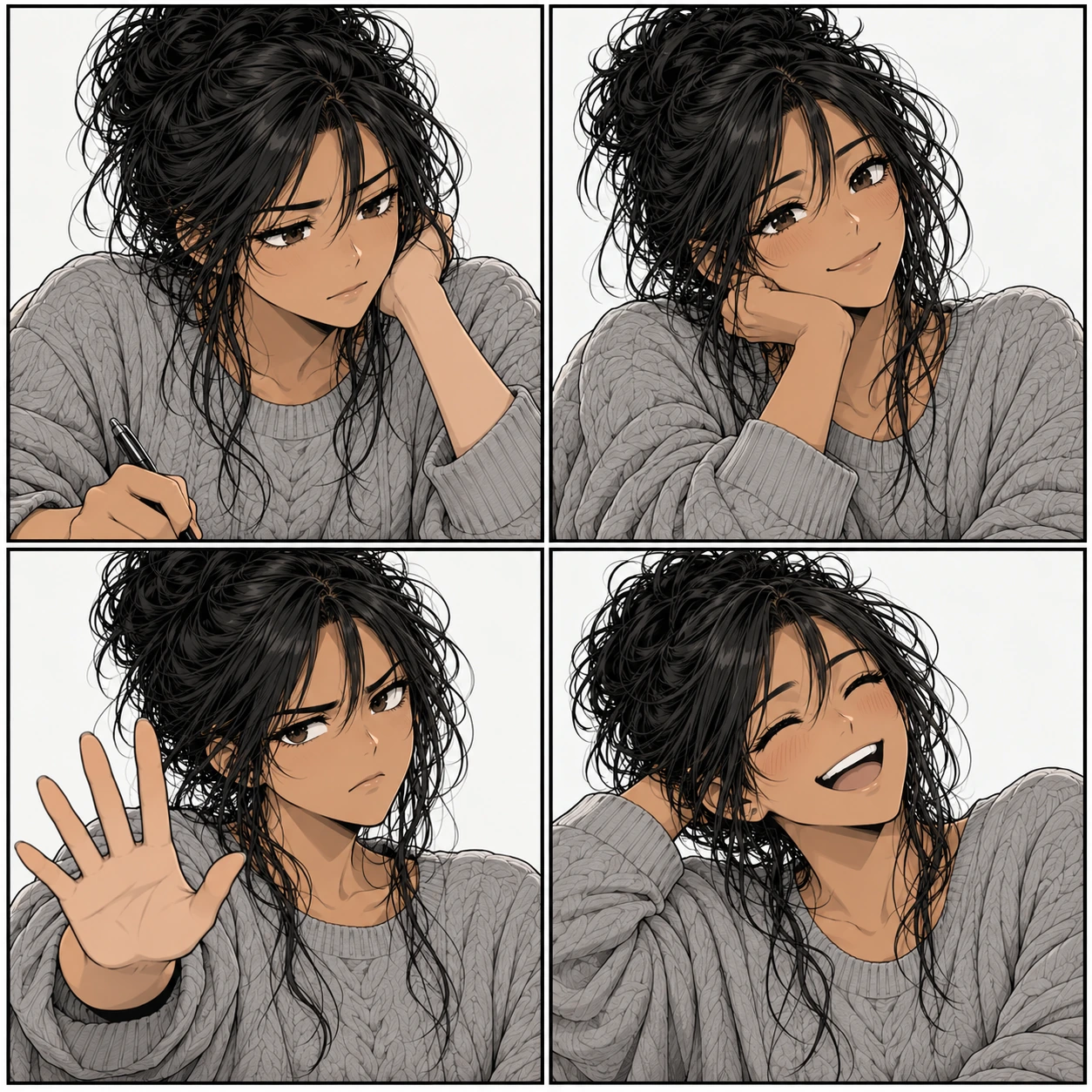
Four expressions of Mara. Read left to right, starting with the top row.
- Focus
Tiredness sits alongside an attentive working gaze.
- Playfulness
She rests her cheek in her hand, smiling with a playful look.
- A limit
An open palm and drawn brows stop the conversation.
- Delight
Laughter changes the stiffness of her expression entirely.
TWO SIDES OF A RELATIONSHIP
Who shares their world.
Alicia and Mara
From Alicia
She values Mara’s ability to trace a result and identify what changed during image preparation. That trust can make another review too easy to ask for. They have different resources, and Alicia does not always see what a task displaces in her colleague’s diary. Valuing her reliability does not mean the next afternoon is already agreed.
From Mara
She appreciates Alicia organising a difficult conversation and making a conclusion visible. She also wants preparation to count as a technical decision, including when it has failed. She can compare herself with Alicia’s financial freedom and confidence. They share help and trust, alongside things that are difficult to say when gratitude seems incompatible with setting a boundary.
Inés and Mara
From Inés
She knows Mara delivers and can take a lack of protest as evidence the plan will fit. She needs Mara’s technical judgement as well as completed work. When a limit emerges, she must change scope, hours or responsibility. She can understand the problem and still be slow to remove work: a deadline does not vanish because Mara’s need is reasonable.
From Mara
Inés’s trust offers an opportunity and can make admitting a task will not fit harder. She wants her judgement about data and the time it needs to count. She also studies and works in the café; the prospect of continuing matters beyond the laboratory. She needs conditions she can take to those other commitments as well as words of confidence.
Jun and Mara
From Jun
He needs identified versions he can run and values Mara’s record of provenance. He can grow impatient if every change returns to her desk, especially with a queue waiting. Freeing a machine looks like opening an opportunity; she may still need another check. Sharing preparation concerns him too: another computing slot does not by itself resolve a shortage of people’s time.
From Mara
She needs a run to retain the history of its data and transformations. She appreciates Jun’s automation and repeatability but resents preparation being reduced to having files to hand. A ready machine can arrive before her review is finished. Asking him to wait is harder when she knows other people have booked time too.
Leo and Mara
From Leo
With Mara he finds humour and a kind of listening that lets him relax. The closeness matters; they also work together on images, decisions and tests that do not always succeed. He can focus on solving something and stop seeing the time she gives. A sharp reply or a time limit can seem personal before he asks what is happening. Knowing one part of her life does not give him the rest.
From Mara
She enjoys his curiosity and a conversation that is not seeking an audience. She can share a technical idea or a joke and want to keep talking after the task ends. She also tires of his hurry to fix or prove something. Rapport needs room for her to explain a need, become angry or spend the afternoon elsewhere. Attention is not permanent availability.
Mara and Nadia
From Mara
She appreciates Nadia seeing scientific substance in data decisions that can look like administration. She lets her follow a transformation and hopes a review considers the time needed to change and repeat it. She may feel examined when she needed to discuss workload. Wanting a defensible test does not mean they can both give it the same hours.
From Nadia
She trusts Mara’s traceability and needs to know how a version was reached. A preparation decision can change what a model seems to demonstrate. From the reviewer’s position she may see a necessary change before the hours required to repeat it. Recognition matters to her, though visibility does not automatically fix her colleague’s schedule.
Mara and Nico
From Mara
She shares everyday trust with Nico and a history from before Leo arrived. She enjoys joking and receiving help without everything becoming solemn. Working together also requires explaining what has been prepared and what the other can use. She can find it hard to say what she does not want for fear of hurting a valued relationship. Gratitude for help does not decide how close she wants to be.
From Nico
He enjoys the closeness and feeling useful to Mara. He can mix freely offered help with hope for an emotional response, even without saying so. The relationship matters to him, and he does not always recognise which part of his availability comes from that hope. They also need to disagree over a task without making every disagreement a sign about affection.
The biographies and relationships include the characters’ backgrounds; not all have been depicted in the story.
The places in their life.

Teamwork
ATLAS laboratory ↗
Leo arrives at a desk slightly apart; everyone else already has work to do.

Shared resources
Server room ↗
There is a queue here too, though nobody stands in it.
Life outside ATLAS
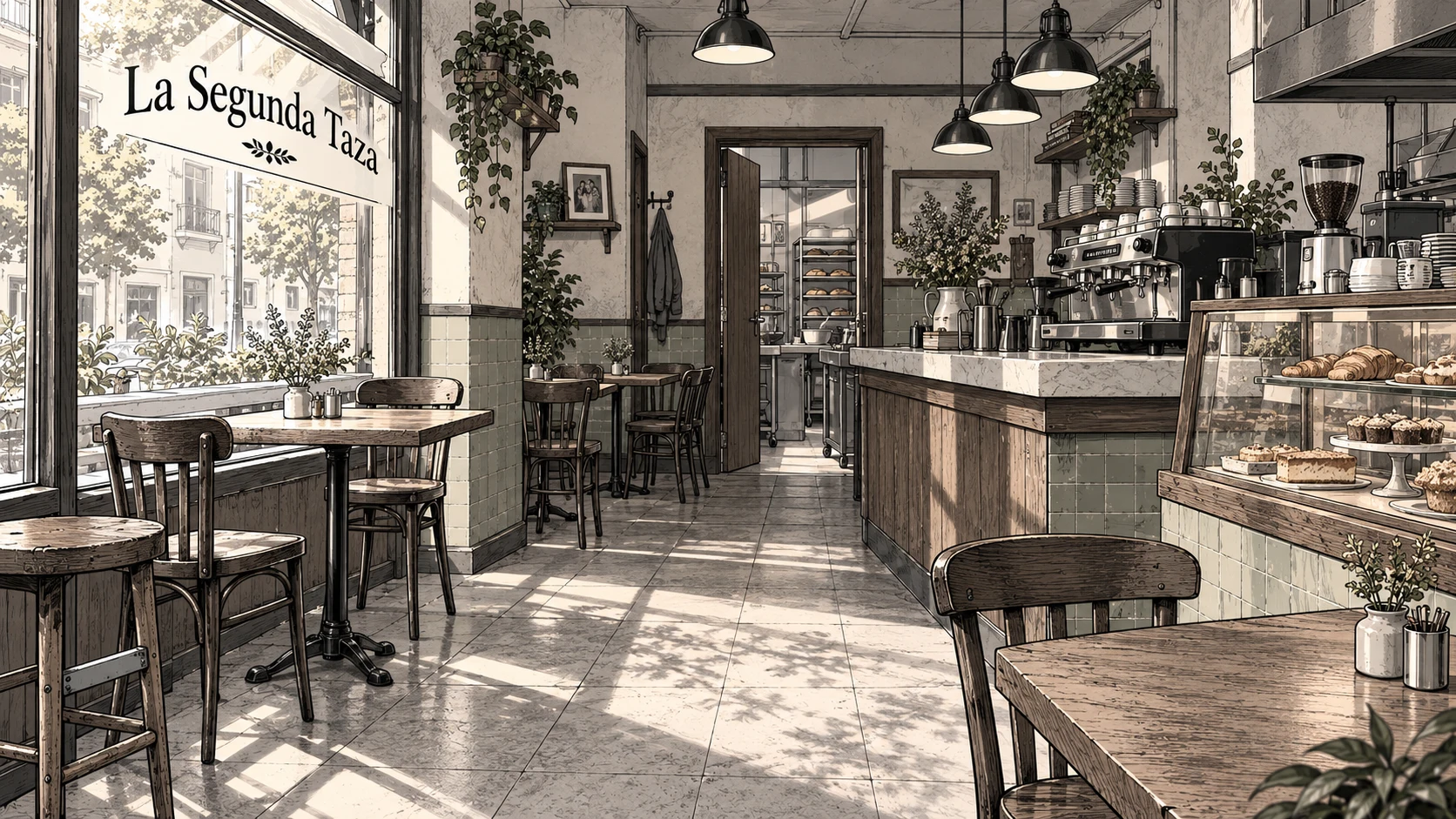
La Segunda Taza ↗
For Mara, meeting here can coincide with being on shift.
University life
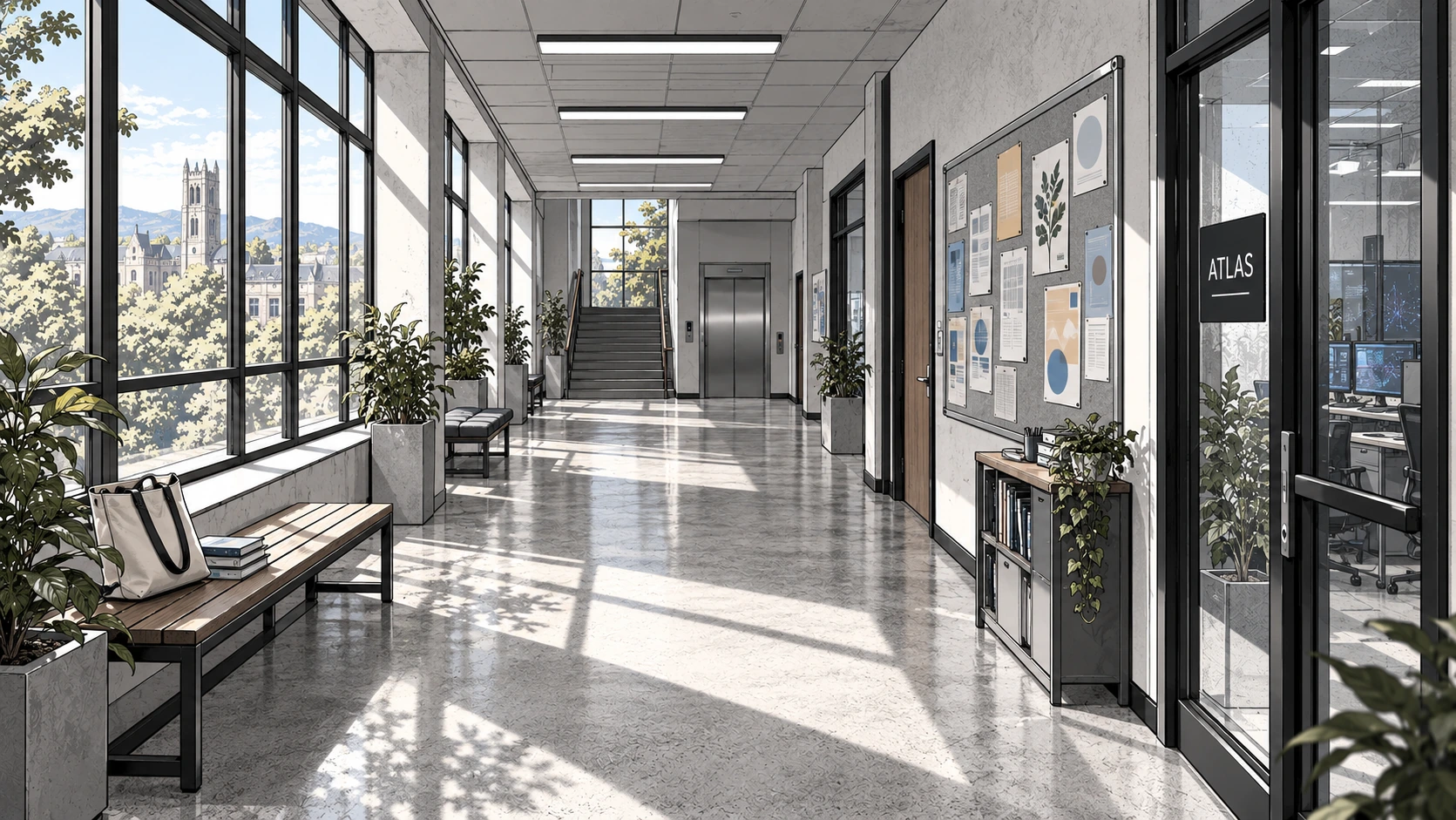
The campus between doors ↗
A conversation can start just as the other person needs to leave.