
FOLLOWING THE STORY
Following the story and its explanations
The volume allows the research and Leo’s life to be followed in one reading. The author’s introduction and a technical introduction come before the story; later reflections help us return to what has just happened. You can read the complete book in English or return to the Spanish original.
How to read Book 1
You can follow the story continuously and return to the explanations, or pause after each part. Within the panels, Leo takes stock from his own experience. Outside them, the reflections distinguish the technical question from a reading of what he is learning and what he still finds difficult.
The introduction explains Kaggle, the task in Benchmarking WSI Privacy and how we might prepare a comparison. You can start reading and return to it when a word or score needs explaining. If a missing explanation makes a scene hard to follow, that observation is particularly useful during this review.
What they are trying to do and what each person needs
In each technical scene, look for three things: what they are trying to achieve, how they will know it has worked and what they will do if it fails. You do not need to recognise every tool’s name. When a score appears, ask what was compared and which decision it allows. An installation that finishes demonstrates something different from a test that supports a hypothesis.
In a conversation, also ask what each person wants from that moment. Leo may want to show an idea while someone else needs to finish an explanation or leave on time. Tension often grows from these different expectations, even when both have good reasons.
The map of a test
Query and gallery mean the image we want to link and the candidates we compare it with. Data then have three uses: learning, choosing settings and checking the chosen approach with reserved material. The split file records where each patient belongs; the vision model processes the images. The programming agent uses a language model, or LLM. In this story both use deep learning, but they are asked to do different jobs.
Specifications record what is to be built and how it is intended to be checked. For an agent to use them, they must be among the information it receives or consults. Writing them does not retrain the model or guarantee that a test is well designed. The record makes it possible to return to a decision and correct it with less guesswork.
What Leo writes and what he does afterwards
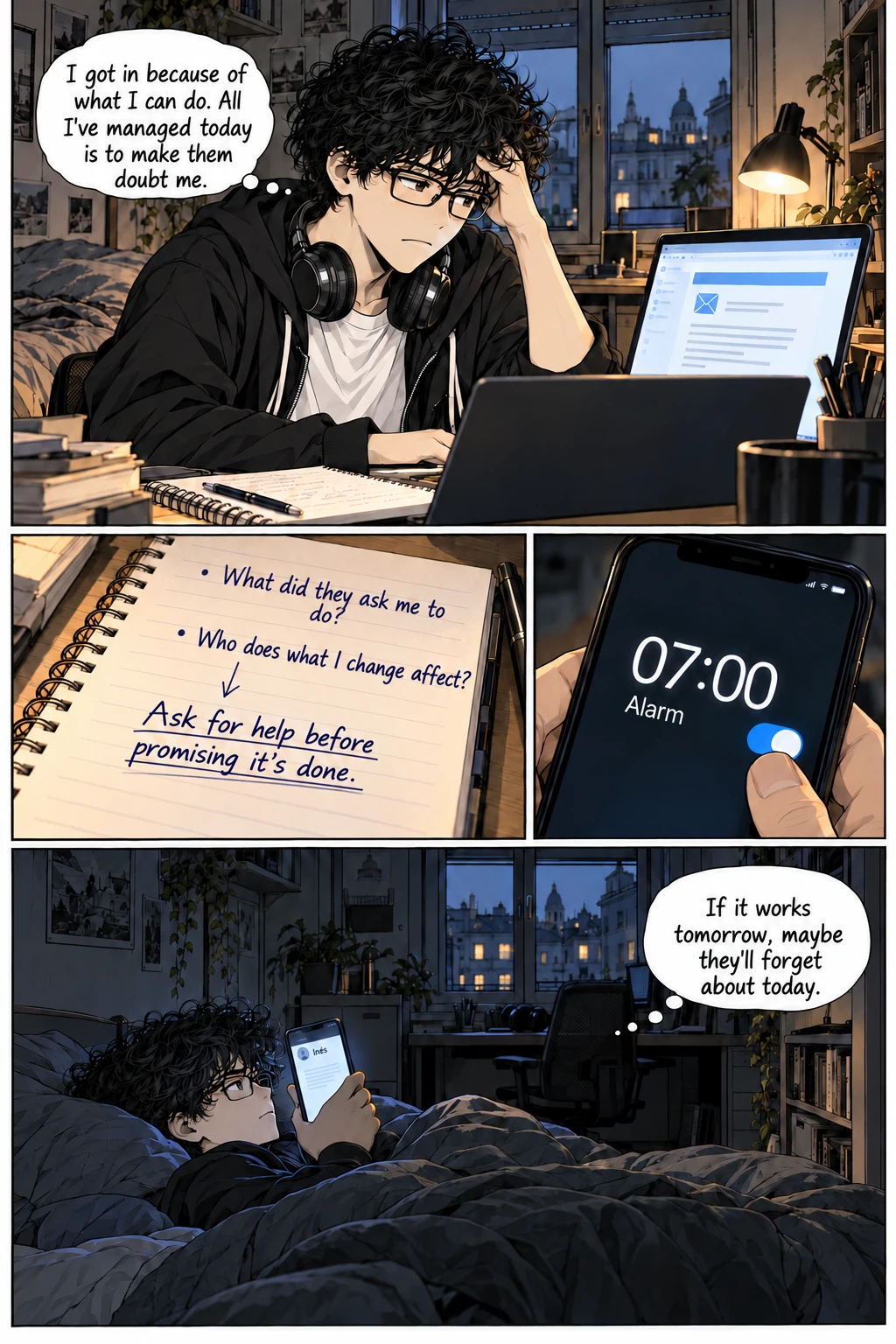
In his notebook, Leo tries to understand what happened during the day. He can recognise a mistake and still hope a good result will also fix how he feels. When he writes down an intention, notice the next similar situation: does he remember it, can he act on it, and what happens if he makes the same mistake again?
The book gives him ideas to try. Putting them into practice takes further attempts: going to the gym, returning with a scene prepared or letting someone else use the keyboard. Following those attempts shows what has changed and what remains difficult. Remembering easily does not settle movement or a conversation about affection; trying again does not guarantee success this time.
Leave room for what Leo does not know
Distinguish what a scene shows, what Leo interprets and what remains unknown. A conversation he does not witness can explain a pressure to the reader without giving that knowledge to the protagonist. Silences, hands and the distance between bodies convey information that does not always fit into a speech balloon.
You can also follow Mara, Alicia or Nico for a while: what they were doing before Leo arrived, what he asks and what they would have to postpone to help him. The profiles expand those circumstances. Returning to the scene can make a reply that seemed unfriendly much easier to understand.