
FROM A PERSONAL EXPERIENCE TO MANY LIVES
Origin and creation
Roberto draws on his own experience to explain the vampire metaphor. From there, he builds a story about a young man who can do many things and struggles with others that are fairly ordinary: listening, asking for help or accepting that someone has no time for him. The AI competition lets us see those difficulties while the team tries to get its work done.
Roberto Canales and the personal starting point
Roberto Canales is a communications engineer, holds a master’s in artificial intelligence, is an entrepreneur and considers himself a very creative person. In the introduction, he recalls childhood diagnoses of giftedness and attention deficit. He treats hyperactivity with humour: people who know him, he says, need no diagnosis to notice it. He is describing himself, rather than diagnosing the characters.
People often approach him because they recognise similar behaviour in themselves, a friend, a child or a nephew or niece. They want to hear what happened to him and what helped. Those conversations also feed into the comic. Leo allows a journey with mistakes and changes to be told, while Mara, Alicia and the others have problems of their own that will not wait for him to understand them.
The article behind the metaphor
The starting point is “Altas capacidades, hiperactividad y déficit de atención: como un vampiro en un mundo de humanos”, published by Roberto Canales Mora on 26 August 2025. The title concerns giftedness, hyperactivity and attention difficulties, framed as a vampire living among humans. The author writes from personal experience about attention, living with others, intense interests and the effort to understand himself. The vampire image expresses a distance between certain abilities and certain difficulties in a shared environment.
You can read the article separately. It is a personal text, originally written in Spanish, with Roberto’s opinions and way of expressing himself. Here it helps explain where the comic began; the story then concerns what happens to Leo and the people he meets.
The vampire describes an experience
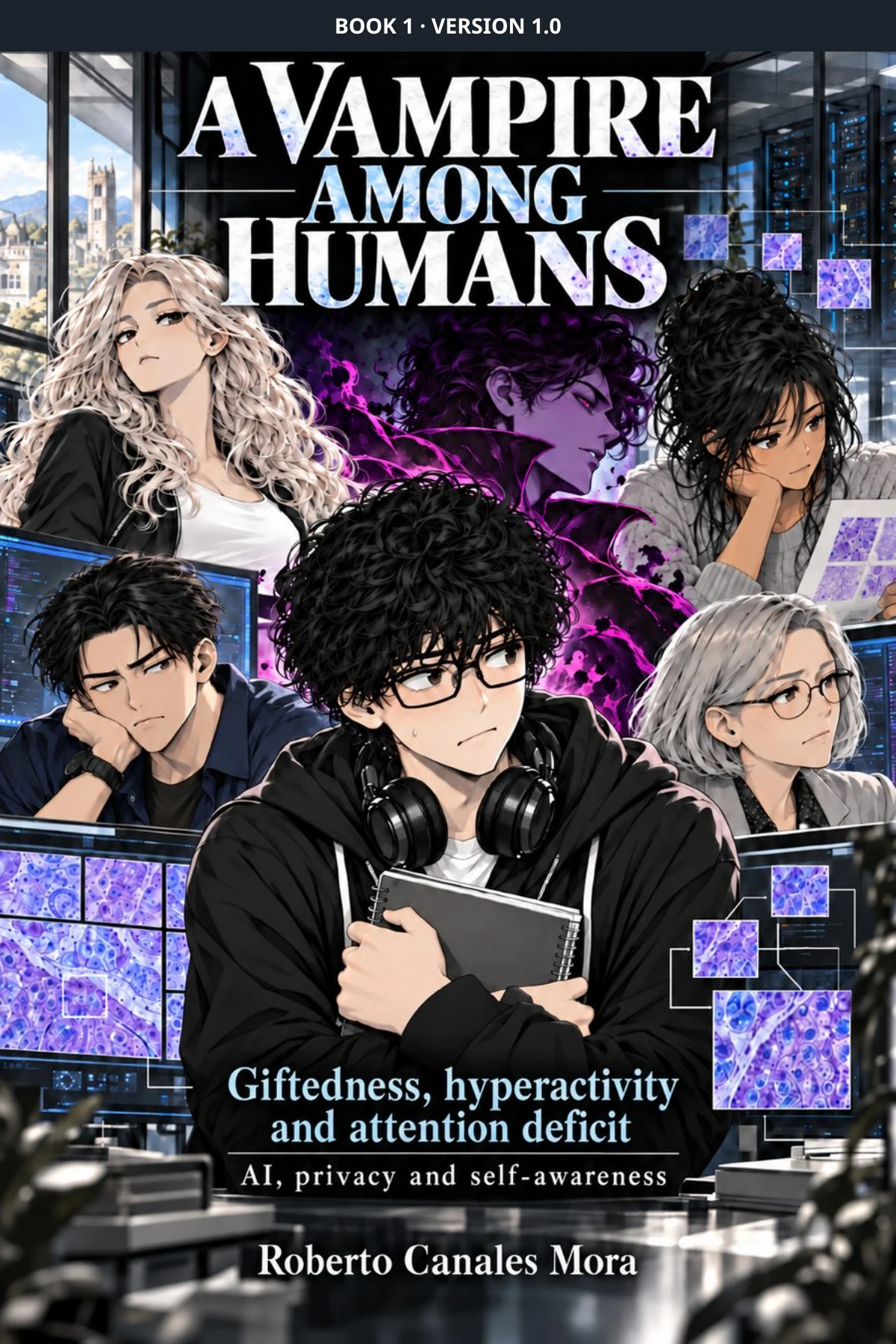
The vampire on the cover represents the feeling of being made differently and having to learn to live with other people. Leo’s world consists of classes, work, family and friends. He can read a gesture as rejection and spend the afternoon turning it over. He can also spot a problem others missed. He needs to learn how to use his abilities and manage what makes life difficult for him.
Leo also gets other people wrong. An objection that hurts him may have a professional reason; Alicia may look confident to him when readers already know about a worry of hers. That difference in information helps us understand a misunderstanding without having to find someone to blame in every conversation.
A reading that prompts action
Leo finds “He terminado mis estudios ¿y ahora qué?” — roughly, “I have finished my studies: what now?” — by Roberto Canales Mora and begins connecting it with his own difficulties. Ideas about self-worth, care, judgement, diversity and responsibility give him questions to ask. He then has to see what he does with them when tired, feeling rejected or facing an opportunity he does not want to miss.
This appears in small decisions: asking before promising, keeping an activity of his own or listening before offering a solution. One day he manages it and another he gets it wrong again. The book pages drawn in the comic are adapted to the story; Leo’s thoughts are his way of working through the reading, rather than quotations or a clinical prescription.
A real challenge within an invented life
The artificial intelligence setting makes it possible to show abilities, tools and limits through specific tasks. Data must be prepared, the comparison in a test decided and what has been checked explained to other people. Submission pressure reveals less measurable questions: who takes on extra work, who receives recognition and what happens to earlier commitments.
The reference challenge, Benchmarking WSI Privacy, is real. ATLAS, the university, companies, results and incidents in the story are fictional. This distinction allows plausible conflicts to be explored without attributing them to real competition participants.
Authorship, tools and reading
Roberto Canales Mora is the author and directs the editorial work. Codex and other AI tools have helped with the script, illustrations, composition and review. A good deal of work follows image generation: checking that a character remains recognisable, speakers are clear and speech bubbles can be read in the intended order. If those checks fail, the scene is lost even when the drawing looks good.
The language is shōnen manga, read from left to right, with mainly monochrome ink and subtle colour accents. The volume includes the author’s introduction, an introduction to Kaggle and the challenge, and technical and character reflections alongside the story. These supports aim to help readers without AI knowledge follow the decisions, while inviting those familiar with the technology to look at the people too.