
24 years old · Character in Book 1
Software Engineer · development and integration
Nico Serrano
He likes fixing what fails and suggesting something to do afterwards.
A degree in Software Engineering; experience maintaining applications.
Nico is 24, comes from a village in Segovia and studied Software Engineering. He spent a year maintaining applications before joining ATLAS. He builds services, integrates components and checks the path between what someone develops and what another person needs to use.
He talks easily, suggests plans and makes a problem feel less solemn. That helps the group, but also encourages people to assume he adapts to everything. He contributes to that impression when he says “I don’t mind” before asking himself what he wanted.
- What they want
- A stable life, company and work that keeps functioning.
- What is difficult
- Saying what he needs before hiding it in a joke.
- What they contribute
- Integration, maintenance and tests that cross component boundaries.
BACKGROUND AND BELONGING
The team he left in the village
He played football locally. A serious knee injury three years earlier ended that ambition to compete. Rehabilitation was long, with progress and setbacks. He still enjoys sport, though hours on his feet or a flight of stairs can remind him that his body now has a different rhythm.
His old team still has matches, jokes and a group chat he wants to belong to. Reading it can bring company and revive comparisons with who he thought he would become. His family wants stability, with different views about where he should find it. Moving to the city has not made the village a life that no longer matters.
CIRCUMSTANCES AND DESIRE
Building a life in the city
He rents a room, uses public transport and works out when he can go home. Employment has given him experience and some room to manoeuvre, but not unlimited resources. He wants regular friends, decent work and a routine in which he does not have to keep proving he made the right choice.
Social ease lets him start conversations Leo would struggle with. It does not always let him say the difficult thing: that he does not fancy a plan, needs rest or has been hurt by a joke. He can feel lonely precisely when everyone takes him for the person who never needs company.
EXPERIENCE AND RECOGNITION
Integrating, testing and maintaining
He can read somebody else’s code, ask about a poorly explained need and fix faults that rarely become the centre of a presentation. If two components work separately, he still wants to know whether one can accept what the other produces. His tests follow that path through to an output someone can use. He takes satisfaction in a service remaining usable and in the next person knowing what to do when it fails.
He does not measure his worth by the chance of becoming a star researcher. At the same time, he finds it hard to see novelty celebrated while maintenance stays in the background. He may take on a task to feel needed and later discover that the others understood his help as permanent availability.
STRENGTH AND DEFENCE
The joke that avoids a conversation
He understands practical dependencies and asks questions that bring an idea down to earth. His blind spot appears when a familiar route seems reason enough to leave a check unfinished. Knowing something worked yesterday can make him too confident about what today’s newcomer needs.
He avoids arguments until they emerge as humour. A joke can ease tension or hurt somebody who already feels outside the group. Nico does not always recognise the difference in time. He likes being liked and can join in laughter before considering whether he agrees with what is being said.
INTERESTS AND RELATIONSHIPS
After logging off
He enjoys cooperative games, bad television series and cooking for several people. He likes a shared activity that need not become an ambitious project. He wants to leave at a reasonable time and keep commitments nobody in the laboratory has seen.
He and Mara have known each other for longer and share everyday familiarity. With Leo, he can share enthusiasm, compare himself and become tired; with Jun, he shares the satisfaction of a tool working. Affection can mix with expectations he struggles to recognise. Nico wants a relationship in which he can stay without competing to deserve it.
VOICE AND GESTURES
A smile that changes
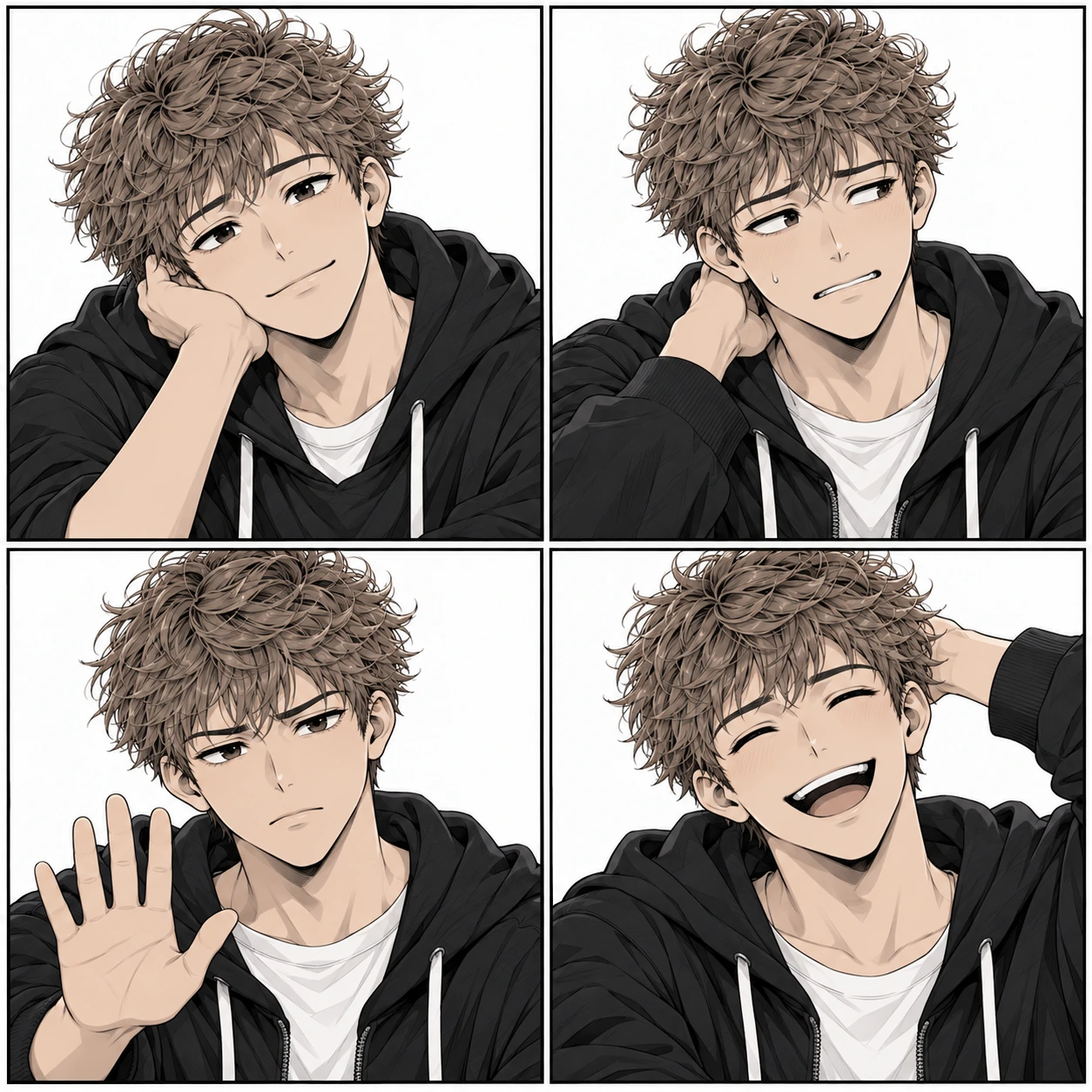
He uses anecdotes and simple comparisons. When making a difficult request, he scratches the back of his neck and delays the sentence. His smile is open when he is comfortable; when angry, he may hold it too still and end up looking down. A listener paying only partial attention can miss the change.
CHARACTER AND EXPRESSION
How their expression changes.
Four expressions of Nico. Read left to right, starting with the top row.
- Easy attention
He listens without tensing his body or filling every silence.
- Discomfort
His mouth tightens and his gaze moves beyond the frame.
- Firmness
His shoulders settle when something really bothers him.
- Laughter
Humour opens his face and makes the moment less formal.
TWO SIDES OF A RELATIONSHIP
Who shares their world.
Alicia and Nico
From Alicia
She values Nico following the whole process and thinking about the user. Examples of what one component accepts and another produces help her explain a result. Tension appears when a presentation calls for a cleaner version than the tool’s actual state. Hearing his objection may require changing something she had already prepared.
From Nico
He appreciates Alicia making difficult-to-show work understandable. He wants the audience to be able to use what is promised, and asks about the difference between a demonstration and a service that will keep working. A simplification can help or commit him to an unresolved task. His disagreement with Alicia has professional substance of its own.
Inés and Nico
From Inés
She needs maintainable tools and knows Nico brings a different perspective from model research. Urgency can make a discovery more visible than the service supporting it. Recognising his contribution means allowing time for tests, handovers and faults. Asking him to help also displaces something he was going to do.
From Nico
He wants a place where practical experience counts and can support a stable life. He needs Inés to see maintenance alongside new developments. He knows a tool can still need work after a presentation. He may fill that gap to feel necessary and later struggle to explain that he cannot keep covering it.
Jun and Nico
From Jun
He appreciates Nico’s stable tools and attention to how they are used. When introducing a solution, he can assume maintenance is covered or request a small test without accounting for the rest of the day. His wish to move forward needs Nico’s work to sustain what they have started. Everyday trust does not determine which hours either can offer.
From Nico
He values infrastructure that lets him concentrate on services and integration. He shares Jun’s satisfaction in fixing something and may accept maintenance without discussion. Later he feels novelty always takes the foreground. He wants to collaborate without fixing one problem making him responsible for every problem that follows, or their schedules being assumed to fit.
Leo and Nico
From Leo
Nico’s ease in starting a plan offers company and brings comparison. He has enthusiasm to share, though he sometimes turns down an invitation because he does not know how to take part. At work he can overlook Nico’s knowledge because a fault seems small or practical. He wants inclusion without acting as the most sociable person and struggles to recognise when he needs someone else to teach him.
From Nico
He enjoys Leo’s intense interest and offers everyday company. He can also compare himself with talent that seems to attract recognition quickly. He knows things Leo still needs to learn and wants a practical question heard in full. An invitation leaves a door open; it does not remove his commitments or make him a permanent companion.
Mara and Nico
From Mara
She shares everyday trust with Nico and a history from before Leo arrived. She enjoys joking and receiving help without everything becoming solemn. Working together also requires explaining what has been prepared and what the other can use. She can find it hard to say what she does not want for fear of hurting a valued relationship. Gratitude for help does not decide how close she wants to be.
From Nico
He enjoys the closeness and feeling useful to Mara. He can mix freely offered help with hope for an emotional response, even without saying so. The relationship matters to him, and he does not always recognise which part of his availability comes from that hope. They also need to disagree over a task without making every disagreement a sign about affection.
The biographies and relationships include the characters’ backgrounds; not all have been depicted in the story.