
27 years old · Character in Book 1
MLOps · runs, resources and agents
Jun Park Etxeberria
He wants the system to work and the working day to have an end.
Computer Science and distributed systems specialisation; professional experience in ML platforms.
Jun is 27, was born and raised in Bilbao and studied Computer Science and distributed systems. His father is Korean and his mother Basque. After working in services and machine-learning platforms, he came to the university to work more directly on experiments.
At ATLAS he handles MLOps: preparing environments, organising runs, managing computing resources and maintaining internal tools and agents. He makes it possible to repeat a test away from its creator’s laptop. He has experience and little patience with a promise that does not explain how it will be sustained.
- What they want
- To deliver something usable without repeating nights of emergencies.
- What is difficult
- Accepting a question his automation does not yet answer.
- What they contribute
- Platform experience, computing and agents that do real work.
ORIGINS AND EDUCATION
A family and a choice of his own
His father came from South Korea to work in logistics and his mother trained as a laboratory technician. Jun grew up in Bilbao, speaks Spanish and Basque, and has a more uneven relationship with the Korean spoken in his family. His history brings these parts of his identity together without having to demonstrate them in every conversation.
He chose computing and later sought out distributed-systems problems. He spent three years between a services business and an ML platform. He enjoyed delivering something usable; he grew tired of a sales promise arriving before the question of what could be done. Research offered a chance to work more closely with experiments, though the pressure remained.
PREVIOUS EXPERIENCE
The recognition for putting out a fire
A migration he completed in the small hours earned him recognition and left him exhausted for weeks. He remembers a review that rewarded him for getting the migration over the line. The documents already in place had done little to prevent the problem.
He learned to trust people who could execute and repair. That experience explains some of his impatience when someone brings a method before getting to know the laboratory. It also leaves him vulnerable to repeating the pattern: becoming the indispensable person who fixes things at the end and accepting the cost as normal.
LIFE OUTSIDE ATLAS
Music after work
He shares a flat with a university friend who works in sound. He produces electronic music, dances and has a group with whom he laughs about tracks he will never release. He likes cooking without following a recipe and losing a game without analysing why.
Going home late or arriving earlier at the laboratory can cost him a rehearsal, a conversation or sleep. That is why finishing on time matters to him. He keeps in touch with his family and argues about ordinary things; when he closes a session, people and plans await him outside ATLAS.
ABILITY AND LIMITS
What a run demonstrates
He recreates software environments, spots costs and can stop a test that would block other people. His agents prepare and carry out bounded tasks, with permissions and checks. He distinguishes calls to an AI service, available memory and a machine’s computing time. His job is to explain those limits and organise the queues; when two needs compete, Inés sets the priority. A free machine does not create time for the person who must review the result.
Sometimes he uses that efficiency as an answer to a different question. An instruction being executed correctly does not mean it was well conceived. He can declare something automated too soon, assume a dependency has been reviewed, or downplay a manual intervention that spoils the appearance of a smooth process.
INDEPENDENCE AND FRICTION
Disagreeing without losing authority
He wants technical independence and fears answering for other people’s promises. Leo’s proposal interests him if it adds a useful check; it irritates him if it seems to demand days of documentation to repeat something he can already do. He can raise a fair objection in a condescending way.
With Mara, he negotiates when data is ready; with Nadia, what review fits the available time. Nico needs maintenance to have an owner too. Inés trusts Jun’s ability to resolve problems, and he can read that trust as more freedom than he actually has. Those arguments are not all about who knows more.
VOICE AND EXPRESSION
Speed, humour and a tightened jaw
He speaks quickly, asks direct questions and uses dry humour. When comfortable, he leans back and moves his hands; faced with a failure, he drops the joke, moves towards the screen and tightens his jaw. He can also feel embarrassed or genuinely celebrate somebody else’s fix. A first impression of confidence can miss those changes.
CHARACTER AND EXPRESSION
How their expression changes.
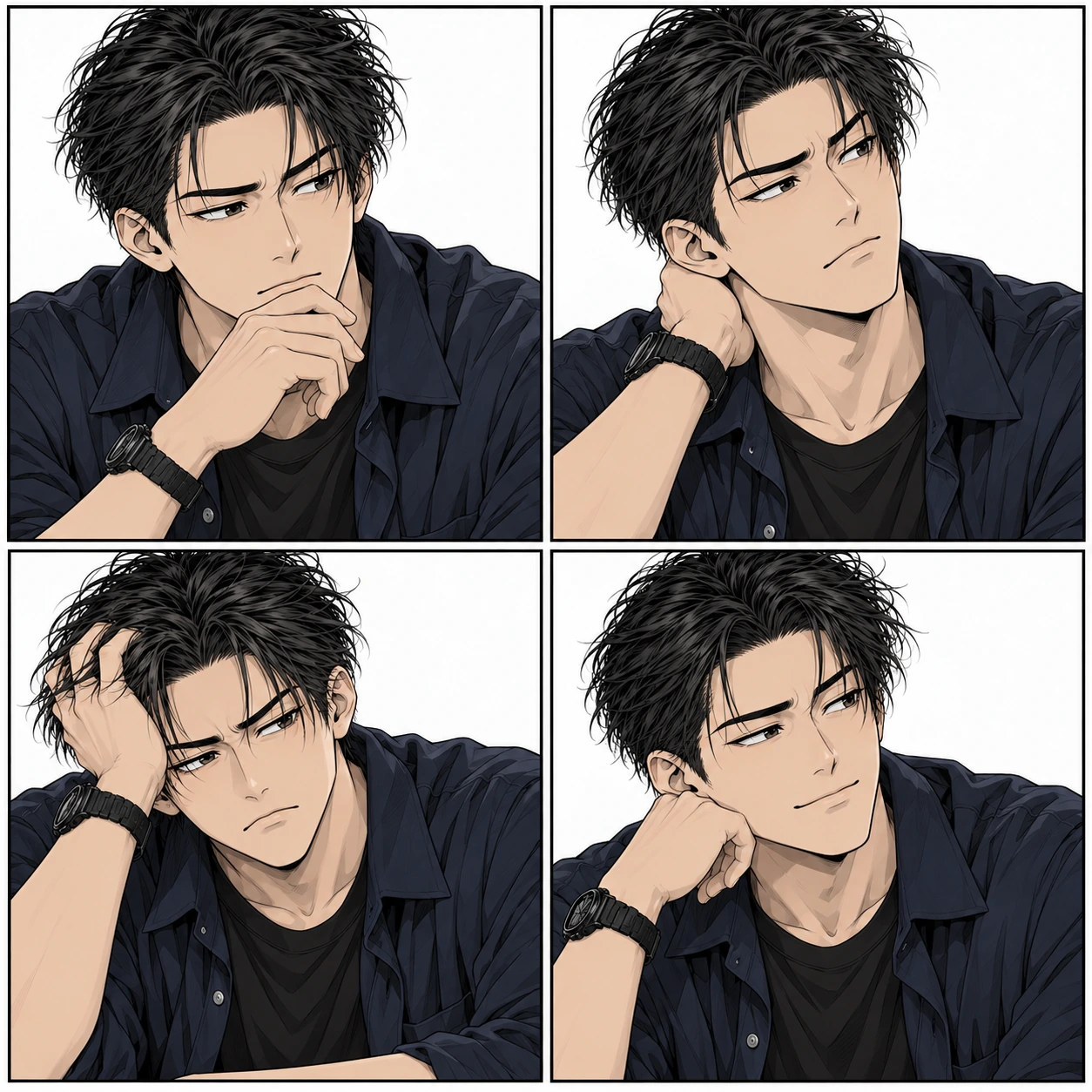
Four expressions of Jun. Read left to right, starting with the top row.
- Focus
His gaze stays still as he considers a response.
- Scepticism
He tilts his head and waits for an explanation that convinces him.
- Impatience
His mouth and shoulders show the strain of waiting.
- Quiet amusement
A half-smile briefly interrupts his seriousness.
TWO SIDES OF A RELATIONSHIP
Who shares their world.
Alicia and Jun
From Alicia
She needs to know the run behind a number: its version, conditions and what was checked. She appreciates Jun making it possible to repeat. She resents an objection about a result being treated as if she were only there to present the work. Her question can change a conclusion even when the program has finished successfully.
From Jun
He wants an implemented solution to be used and recognises the value of explaining it clearly. Giving Alicia what she needs for a review also takes time and records. He can hear the request as a dismissal of his effort, especially when he thought he had finished. Friction lies between making something work and knowing what it supports.
Inés and Jun
From Inés
She relies on technical ability she knows and needs. Jun’s speed can hide the work behind a fix or make her downplay his bluntness. Delegating frees her for other decisions; resolving conflicting priorities remains her responsibility. Trust requires Jun to be able to say what will not fit without proving it through another night of emergencies.
From Jun
He values the independence Inés gives him and a clear place for his ability to solve problems. He needs priorities when tasks compete for the same machine or his time. He can mistake trust for permission to set them alone. He does not want to answer for other people’s promises and sometimes expresses that fear as impatience with a request.
Jun and Leo
From Jun
He appreciates a difficult question when it leads to a concrete check. Leo’s proposal interests him for the work it saves or improves, and he wants to see whether another person can run it. He can have the right objection and deliver it with superiority. Documentation looks like an easily inflated cost to him; impatience can stop him recognising what it does preserve.
From Leo
Jun’s experience brings out admiration and resistance. He wants to contribute something the existing tools do not already solve and can try to prove it before understanding how the team works. A direct question touches his proposal and his fear of being unnecessary. Accepting technical help becomes harder when he thinks the question is who knows more.
Jun and Mara
From Jun
He needs identified versions he can run and values Mara’s record of provenance. He can grow impatient if every change returns to her desk, especially with a queue waiting. Freeing a machine looks like opening an opportunity; she may still need another check. Sharing preparation concerns him too: another computing slot does not by itself resolve a shortage of people’s time.
From Mara
She needs a run to retain the history of its data and transformations. She appreciates Jun’s automation and repeatability but resents preparation being reduced to having files to hand. A ready machine can arrive before her review is finished. Asking him to wait is harder when she knows other people have booked time too.
Jun and Nadia
From Jun
He respects a review that distinguishes what has been checked and enjoys discussing problems with someone who knows their starting point. He can experience an objection as erasing the effort of running the test. Nadia’s part-time commitment reminds him that a ready test does not guarantee an available conclusion. His next step also depends on the question they agree.
From Nadia
She needs the runs Jun makes possible and appreciates their repeatability. She wants to know whether examples used to choose an adjustment have been kept separate from those used to test it. He may see work ready to run where she still sees a poorly framed comparison. Disagreement can produce a better check or a struggle over who may delay the group.
Jun and Nico
From Jun
He appreciates Nico’s stable tools and attention to how they are used. When introducing a solution, he can assume maintenance is covered or request a small test without accounting for the rest of the day. His wish to move forward needs Nico’s work to sustain what they have started. Everyday trust does not determine which hours either can offer.
From Nico
He values infrastructure that lets him concentrate on services and integration. He shares Jun’s satisfaction in fixing something and may accept maintenance without discussion. Later he feels novelty always takes the foreground. He wants to collaborate without fixing one problem making him responsible for every problem that follows, or their schedules being assumed to fit.
The biographies and relationships include the characters’ backgrounds; not all have been depicted in the story.
The places in their life.

Teamwork
ATLAS laboratory ↗
Leo arrives at a desk slightly apart; everyone else already has work to do.

Shared resources
Server room ↗
There is a queue here too, though nobody stands in it.
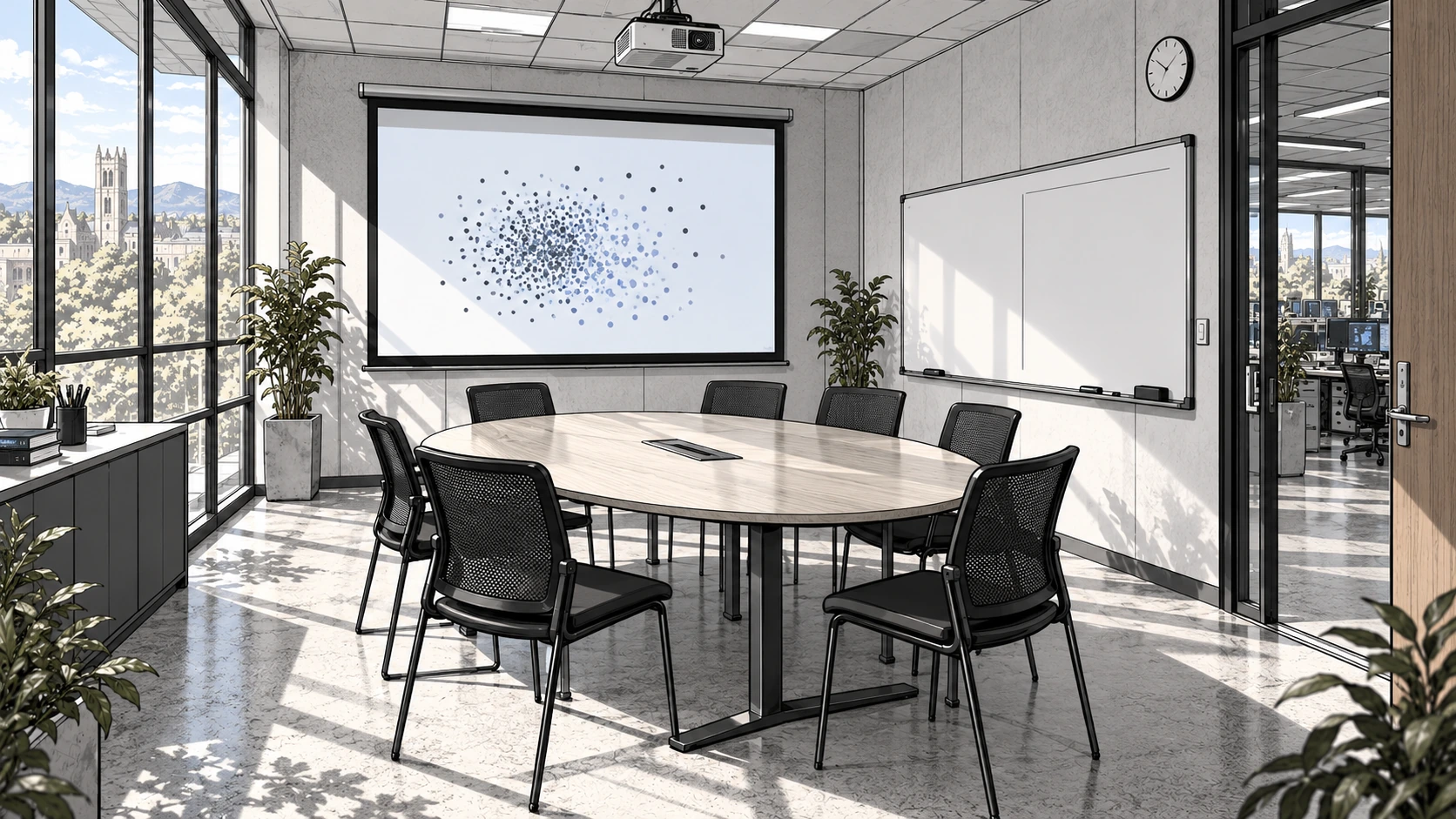
Results and questions
Evaluation room ↗
Before accepting a score, there are a few questions to answer.

University life
The campus between doors ↗
A conversation can start just as the other person needs to leave.