
0. To prosper or to live better
In this chapterI’ll explain why this book begins with a question about our working lives: do we want to prosper, live better, or both?
I’ll connect experiences, books, and models so you can weigh what is useful to you and apply it to your own situation.
You’ll also see why I begin classes by asking for volunteers to search, share, and learn together from the very first minute.
For years I’ve taught at business schools, working with professionals who have already spent a long time making decisions. One of a teacher’s usual frustrations is never having enough time to cover everything they would like. The programmes are intensive, there are many instructors, and each gets only a few sessions. Besides, we aren’t robots: every group moves at its own pace and opens up different conversations. I may explain one thing in a class and then hear an example in another that I would have liked to share the first time around.
That’s why I make myself write from time to time. This book brings together what I usually talk about and what I wish I could develop more fully in the executive education programme. Here I can finish an anecdote, connect it to another one, and add nuance to something that, stated very categorically in class, can wake us up but needs a little more room to be understood. I hope you find it useful whether you’ve been in my classroom or found your way here on your own.
Even so, if you get the chance, I recommend coming to class. Each version of the book is a snapshot of what I’ve learnt and managed to organise up to that point, while the teaching keeps changing. Technology advances enormously, and teachers never stop learning either. Sometimes we even get tired of hearing ourselves repeat the same things, so we look for a different way to explain them, try a new tool, or include something that has just happened to us in a company. The classes I teach are usually richer and more current than what I manage to leave written here.
Besides, I rarely teach the same course twice. You only have to look at the students’ faces to realise that an explanation hasn’t landed, or that an example hits close to home and deserves more time. Attendance, the group’s pace, the number of questions, and the problems students bring up all change what happens in the classroom. A teacher can pause, ask you to tell your story, and adapt the conversation; that interaction produces lessons I can’t predict when I prepare a session or finalise a version of the book. That’s why I like you to use these pages to prepare for the programme, review it, and keep thinking afterwards, and to use the in-person class to compare notes with me and your classmates about what is really happening to you.
I’ll also keep updating the book. If you buy it on Leanpub, you’ll be able to download the latest version I publish from your library, with updates at no additional cost. I recommend checking the version and date on the cover, whether you have the complete book or are reading the sample. I’ll keep naming the specific tools I use because they help explain how I do things, and I’ll revisit those references as the tools and my experience with them change. What you read today should help you act today and reconsider how you work when new possibilities appear.
I don’t teach these courses so people can leave knowing how to recite a methodology. Methodologies are a means, and what interests me is for professionals to prosper in their companies or live better, because if you spend a substantial part of your life working and are also making the effort to attend a business school, it makes sense to ask what you want to get out of all this. Being exhausted, getting home late, and still feeling just as stuck five years from now doesn’t sound like a wonderful plan either.
That’s why I usually start by offering two fairly radical positions: either you aim to do very well and become wealthy, or you aim to live well. If you manage both, excellent. I want us to stop using effort to justify any outcome and start thinking about how we organise our working lives, because working hard does not, by itself, prove that we’re working in the right direction.
When I say wealthy, I mean having assets that give you the freedom to choose, not an expensive car and a collection of monthly payments that force you to keep running. To give you a concrete reference, Capgemini classifies people with at least one million dollars in investable assets, excluding their primary residence and certain personal property, as high-net-worth individuals (HNWIs) [18]. That’s a useful wealth classification for this conversation. Earning a high salary and spending all of it every month is something else. A townhouse in a nice neighbourhood, a large car and a smaller one, children at a good school, and thirty-year debts can look great. But if you live in fear of losing your job because the whole thing would collapse, you’ve bought obligations along with comfort. That’s what Robert Kiyosaki popularises in Rich Dad Poor Dad with the image of the rat race [33]: running faster and faster to keep up with what you’ve already committed to.
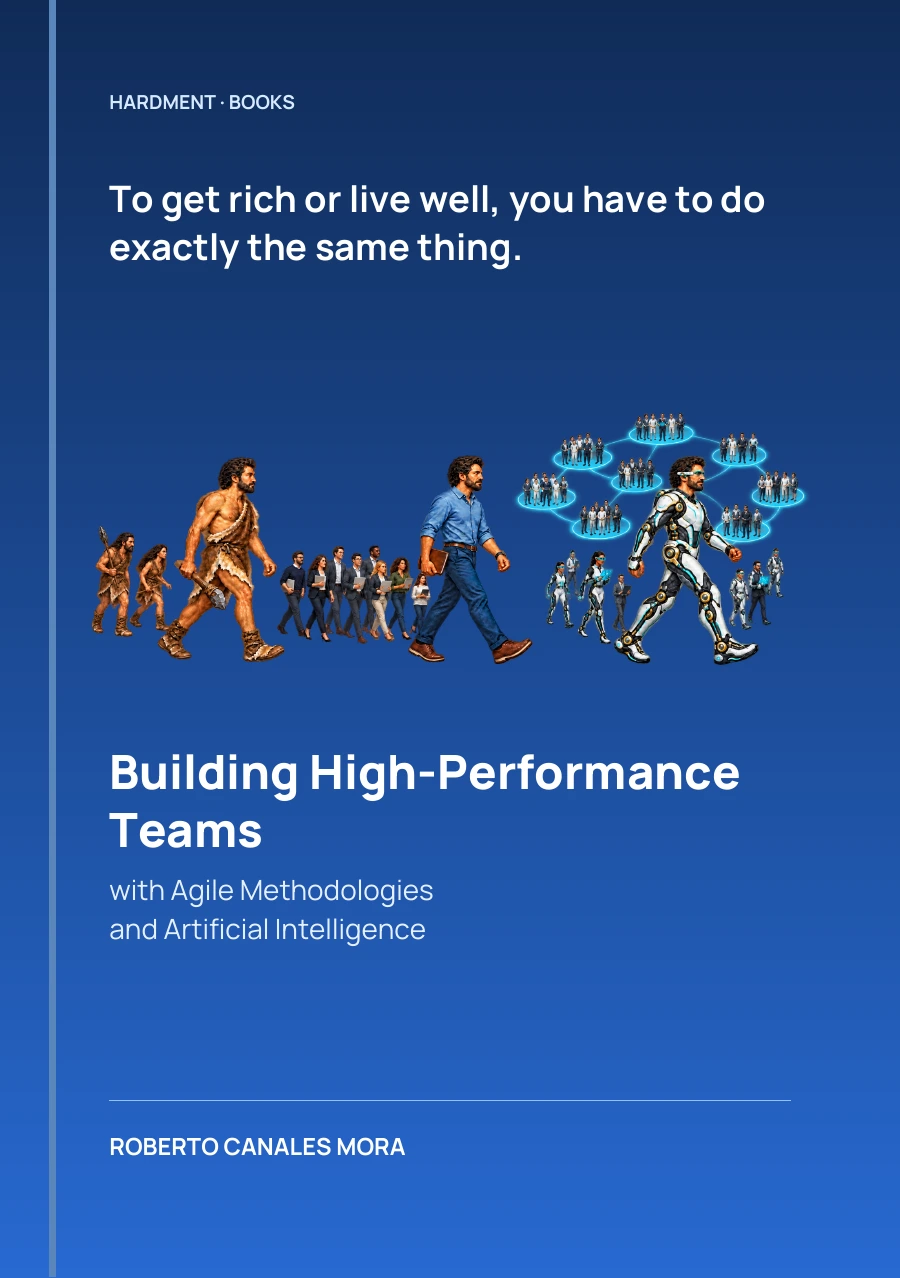
Living well might mean spending more time with your family, being able to take a few days off without the department falling apart, or working on projects that interest you. And here’s the sentence I want you to remember. In both cases, you have to do exactly the same thing: build self-organising high-performance teams. If everything needs you standing right there, you face an obvious limit, both to growth and to enjoying what you’ve built.
Throughout the programme, I’ll connect ideas from books, business experiences, counters we turn over on a table, and conversations with my children. These aren’t detours to entertain us between slides: often we’re seeing the same behaviour in different places. If you always do your children’s homework for them, always assign the tasks, and always answer the questions, you’re training other people to need you. Don’t be surprised later when they won’t leave you alone.
0.1. Grasping ideas and building useful models
Before we begin, I want to make clear how I hope you’ll read what follows. I’ll say some things with strong conviction, some deliberately provocative, and I don’t expect you to swallow them whole. I want you to grasp these ideas, not just learn them: listen to what I tell you, connect it to what you already know, test it, and keep what you can use. If you’ve been working for twenty years, your judgement on many things may be as good as your teacher’s. I’m not asking you to abandon it; I’m asking for a little humility as you look for what you can transfer from someone else’s experience to your own situation, even when their company or way of speaking is nothing like yours. If an idea makes you uncomfortable, take a moment to understand what I’m trying to point out before deciding whether you agree.
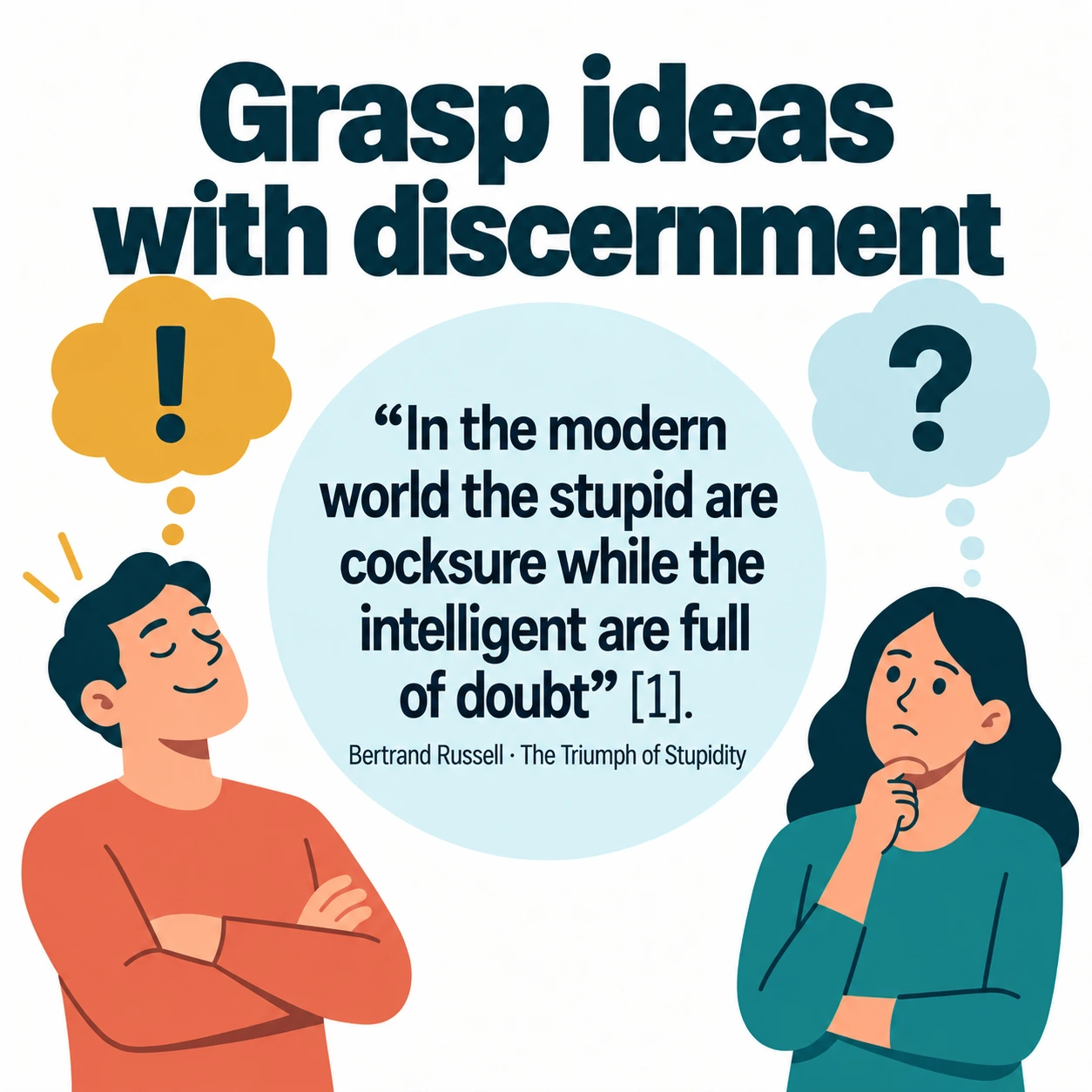
I often recall this thought from Bertrand Russell, in his original English: “In the modern world the stupid are cocksure while the intelligent are full of doubt” [1]. It applies to me too: having run a company or explained something many times doesn’t turn my opinions into universal truths. I’m sharing my experience, models, and judgement so you can build your own. Let’s agree on that here, at the start, so we can talk without interrupting every example to apologise for all its possible exceptions.
Since I come from computing, I explain it in bits. If I had only one bit in my head, I could choose between zero and one; with eight bits, I’d have values from zero to 255. So let’s try to make use of those degrees. I don’t need to agree with every idea from a political party, every page in a book, or every practice in a methodology. I heard Javier Recuenco express the idea that you shouldn’t buy all your fish from the same person. Even a fishmonger who usually treats you well might one day be interested in getting rid of a piece that isn’t such a good deal for you. We can trust and still use our judgement. The same goes for a political party: if I accept and defend everything its leader says, whatever it may be, I’m not showing much independent judgement; I’m turning into an easily led disciple.
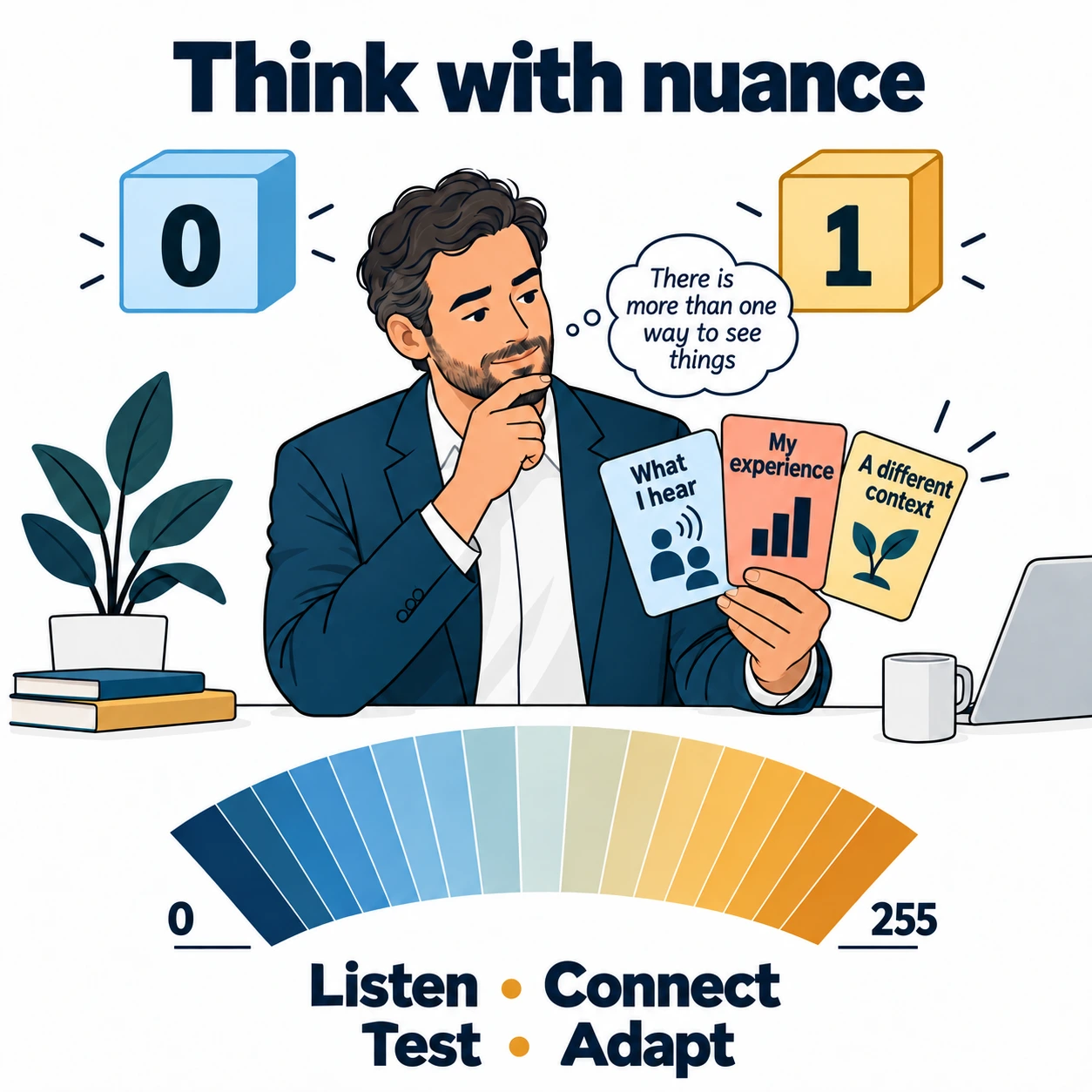
Recuenco’s invitation to keep our judgement fits with another line he often recalls: “All models are wrong, but some are useful,” whose original formulation is attributed to George Box [17]. I connect it to what I want to do in class: all models are wrong, but some are useful, and what we want is to build heuristic models for success. A heuristic helps me guide a decision when I don’t have all the information; afterwards, I have to see what happens and adjust my judgement.
That means I can tell you, “stop assigning tasks,” and then spend several pages explaining how I teach people to find them, what context they need, and when I step in. If you take only the slogan away, you can get a disastrous result; if you water it down until it means nothing, you won’t change much either. The point is to understand it and try it thoughtfully in your own situation.
I’ve been teaching agile methodologies for years, but it would make no sense to keep teaching the same class I taught two years ago as if artificial intelligence didn’t exist. Some practices now let us prepare in minutes what used to take days to put on the table; others still require conversation, judgement, and agreement among people. That’s why AI appears from the beginning and runs through the whole journey. I want us to use both to build a culture of self-organising high-performance teams, able to deliver value without having the person in charge solve everything for them.
This handbook preserves that journey so you can return to it after the programme. First I’ll talk about developing our own capabilities and how we learn; then about the value and relationships that make a team work. We’ll look at the models I use to think about work and a game that lets us test them. We’ll follow Lean principles, get into Kanban, and end by tackling projects we don’t yet know how to define fully. Scrum and XP will have their place once we understand what problem we want to solve.
I don’t want you to finish the book with a collection of new names and an equally full calendar. I want you to find things you can do, things you can stop doing, and people with whom you can build something lasting. We’ll return to that idea often, because prospering with people you enjoy working with has a lot more staying power than winning an argument on Tuesday morning.
0.2. Learning together from the very first minute
At the end of each chapter, I’ve gathered the ideas I want you to take away as laws: a first sentence to help you remember them and a second to put them to work. They are numbered consecutively throughout the book, so we can refer back to one without repeating it in full every time.
There’s an activity I propose at the beginning and that we’ll repeat throughout the course. I ask, “Who’ll do it?” and I want someone to say “I will” before they even know whether they’ll have to find a book, check a reference, or ask AI for an explanation. The task will be small, and someone else will take the next turn. The person who does it reviews what they found and shares it with a little context in the class WhatsApp group; a small individual effort benefits everyone.
We can also ask someone in each session to collect the important phrases and concepts. I don’t need the whole class to focus more on copying than listening. If we rotate that responsibility and organise our notes into a map at the end, we all get a resource that would have taken one person much longer to prepare. I encourage you to do this in other teachers’ classes and in your departments too. We’re already practising initiative, sharing the work, and managing knowledge before we study a methodology.
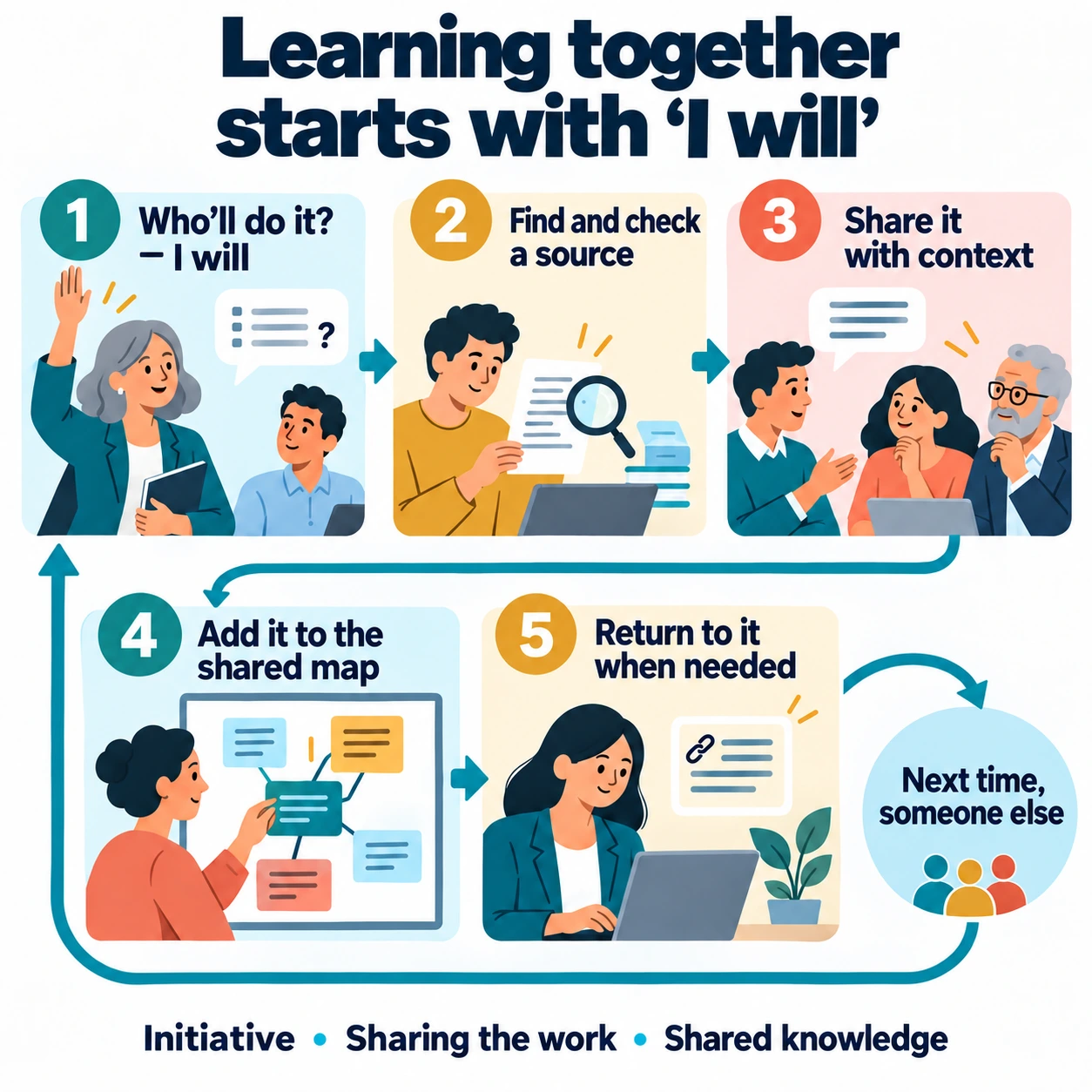
Later, when I ask you to look up what muda means or prepare a talk, we’ll be using the same activity. And if you’re reading the book on your own, you can look it up then, save a note with its source, and think about whom you’d like to share it with. You don’t have to wait until you finish the book to start building a team.
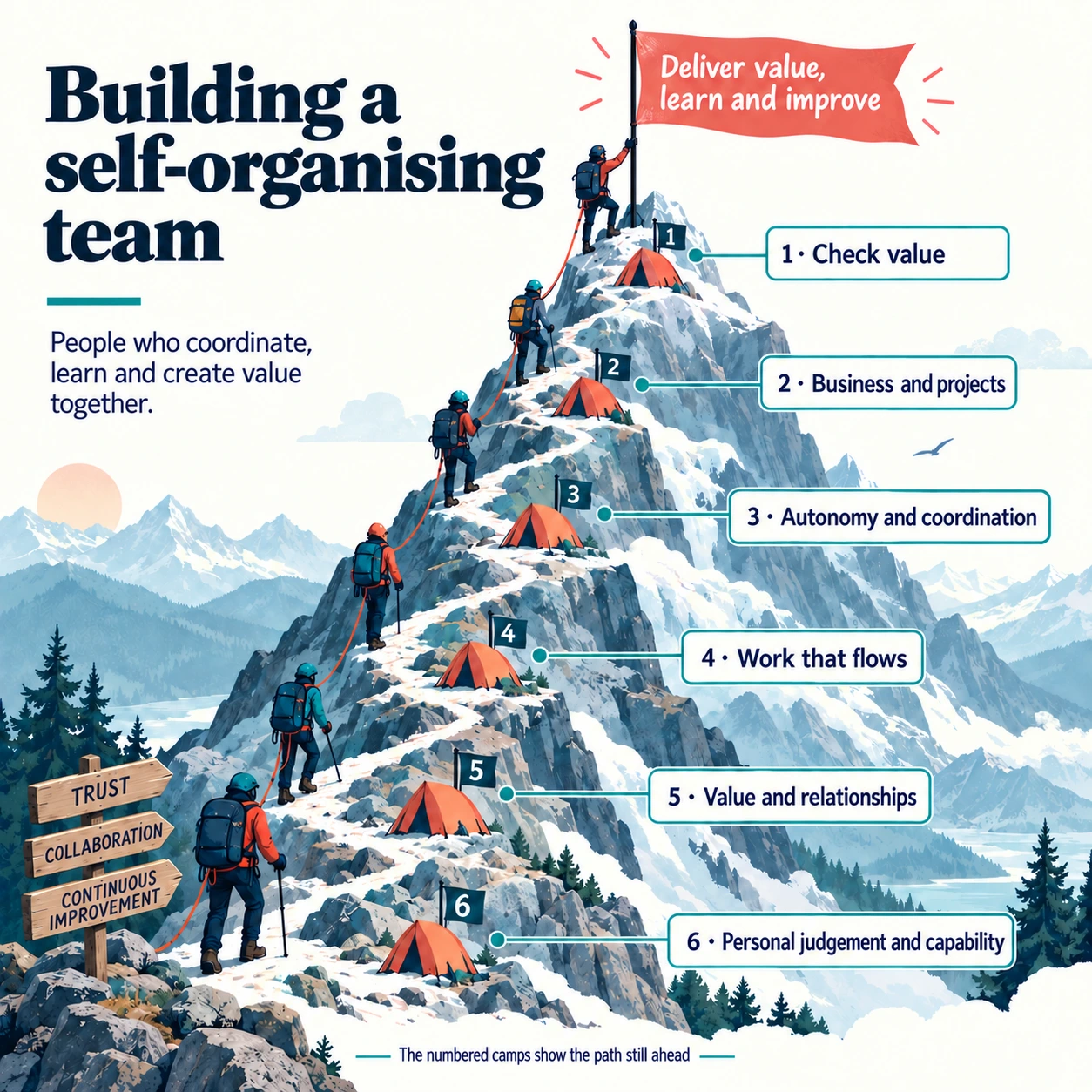
I’ll use a mountain to help us find our way. The summit is a team that delivers value, learns, and organises itself without needing the person in charge at every step. The camps are numbered in reverse, like the steps still ahead of us: Camp 6, personal judgement and capability; Camp 5, value and relationships; Camp 4, work that flows; Camp 3, autonomy and coordination; Camp 2, business and projects; Camp 1, checking value and sustaining improvement. This is a convention used in this book, not the usual numbering of an expedition. Trust, collaboration, and continuous improvement appear at the base of the illustration because we’ll practise them throughout the climb: sharing a question, keeping an agreement, or correcting a way of working together are all ways to start building them. We keep learning and improving at the summit; self-organisation also means sustaining that work without waiting for me to push it forward.
0.3. What we take away to build the team · Laws 1–3
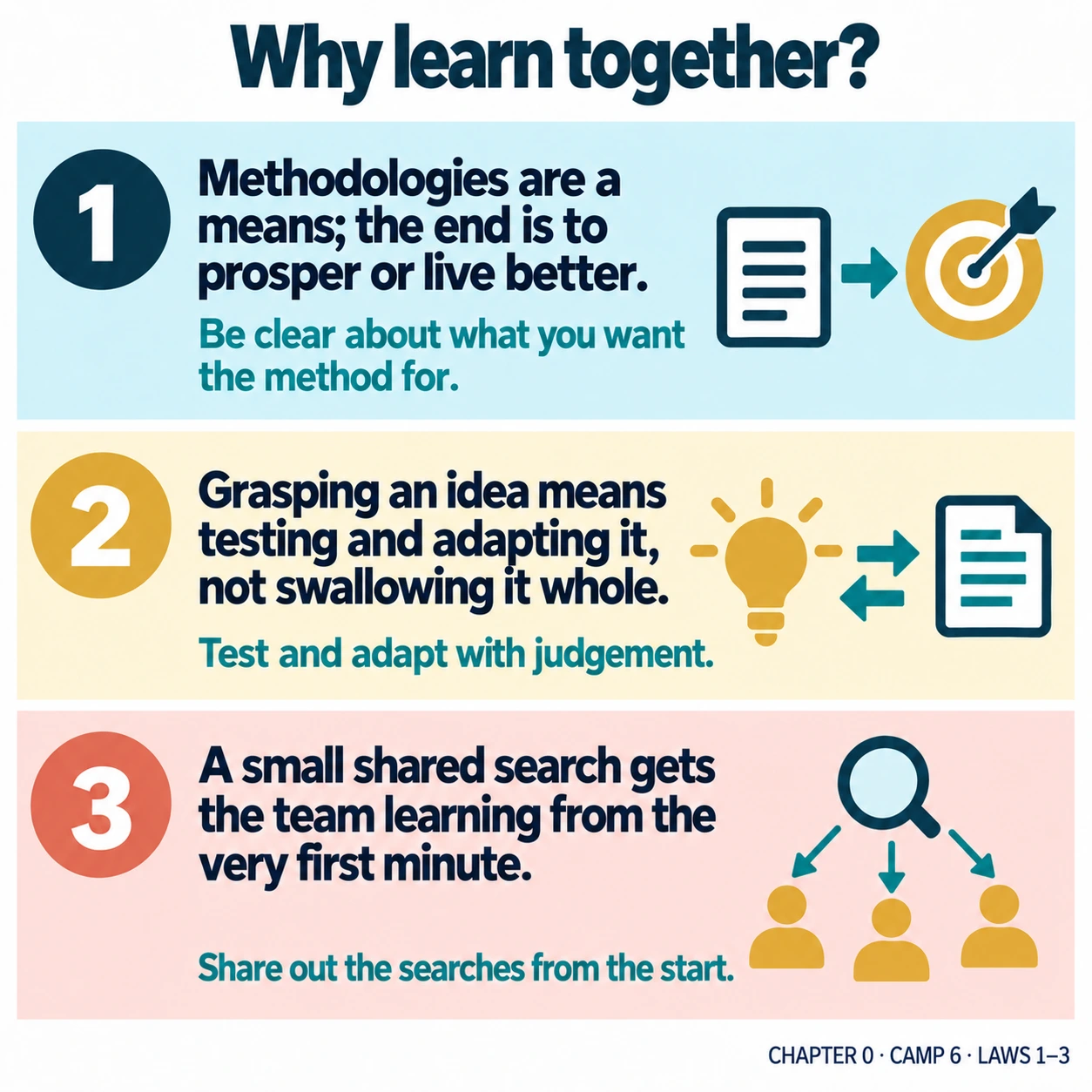
Law 1. Methodologies are a means; the end is to prosper or live better. Before choosing a practice, be specific about how it will help you deliver more value and build a team that can work without depending on you at every step.
Law 2. Grasping an idea means testing and adapting it, not swallowing it whole. When you hear a categorical statement, look for the problem it points to, compare it with your experience, and try the part you can use.
Law 3. A small shared search gets the team learning from the very first minute. At your next session, rotate who looks up a reference, add the source, and share a sentence of context with the group.
The first capability I want to build is a shared sense of purpose and the confidence to contribute from the start. If everyone waits for instructions even for a small search, it will be difficult for them to organise complex work with others later. That’s why the course begins by practising initiative and judgement before naming the methodologies.
Now that we’ve agreed on why we’re here and how we’ll learn, I want to start with our own capabilities. It would be difficult to ask someone to change how they work if we aren’t willing to review our own way of working.
1. Developing ourselves so we can develop others
In this chapterWe’ll start with our own capabilities: adopting tools and learning to work with AI, while applying judgement to data and results.
I’ll tell you how I use dictation, automation, and a logbook to make better use of my time and what I learn.
Then we’ll look at how to get more out of a book and share knowledge so it reaches the team too.
1.1. Updating our software and working with AI
The first thing we need to do is develop ourselves so we can develop our teams and the people we work with. I often say that we have hardware into which we need to keep installing software: we’re still ourselves, but we need new knowledge, new judgement, and tools that let us do things we didn’t know how to do before. If all your time goes into repeating what you already know, where will that new capability come from?
Artificial intelligence needs to be a priority tool at work right now. I don’t understand how a professional who wants to prosper can fail to make a conscious effort to learn to use it, much less how a manager can fail to help their team do so. “I’ll get to it when I have time” doesn’t work for me: we’re talking precisely about gaining the capacity to work better. When I prepare a presentation, an explanation, or an analysis, my first question is how AI can help and what I need to check to make good use of its work.
Before choosing a tool, let’s remember why we want it. We need to deliver value to our customers and our organisation. An architect can design a house on their own; designing a city requires many capabilities working together. When we think of Apple or SpaceX, we remember one person who embodies leadership, but there are whole teams behind them. I’d tell the lone wolves to question the illusion that they can do everything themselves: tools make us more capable, but big things still require us to work with others.
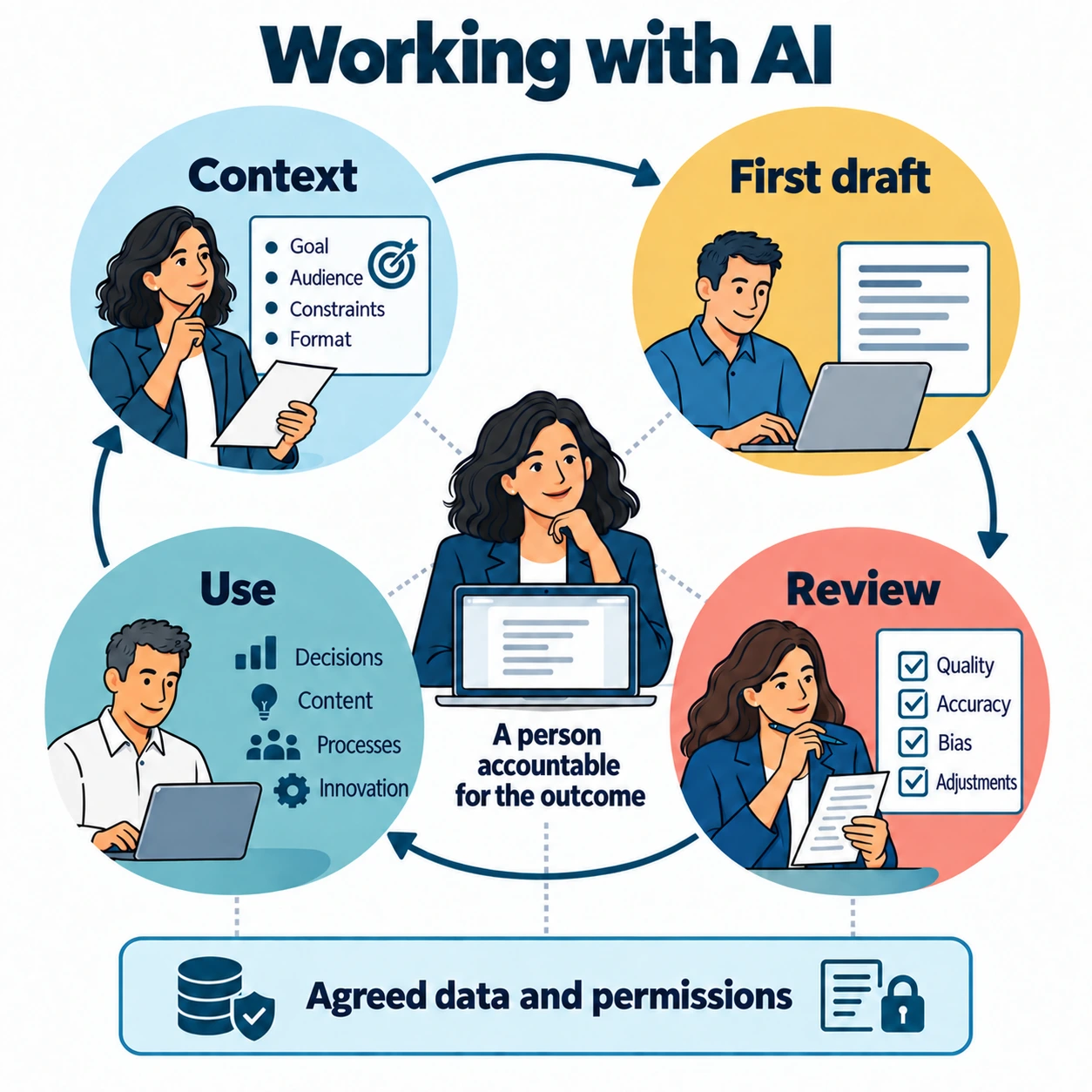
Suppose I need to prepare a presentation for my team. I explain to AI what we need to decide, who will be at the meeting, what data I have, and what format would work for me, always using information we’re allowed to share with that tool. I ask for a first draft and review it: if a figure has no source, I check it; if it suggests something our team can’t do, I explain that and we adjust. Then I use the presentation to talk and make decisions with people. That journey—context, first draft, review, and use—is what the figure shows. I’m still responsible for the result, and in section 1.3 we’ll look at how to give the whole team some rules for working this way.
1.2. Dictating, walking, and revising this very book
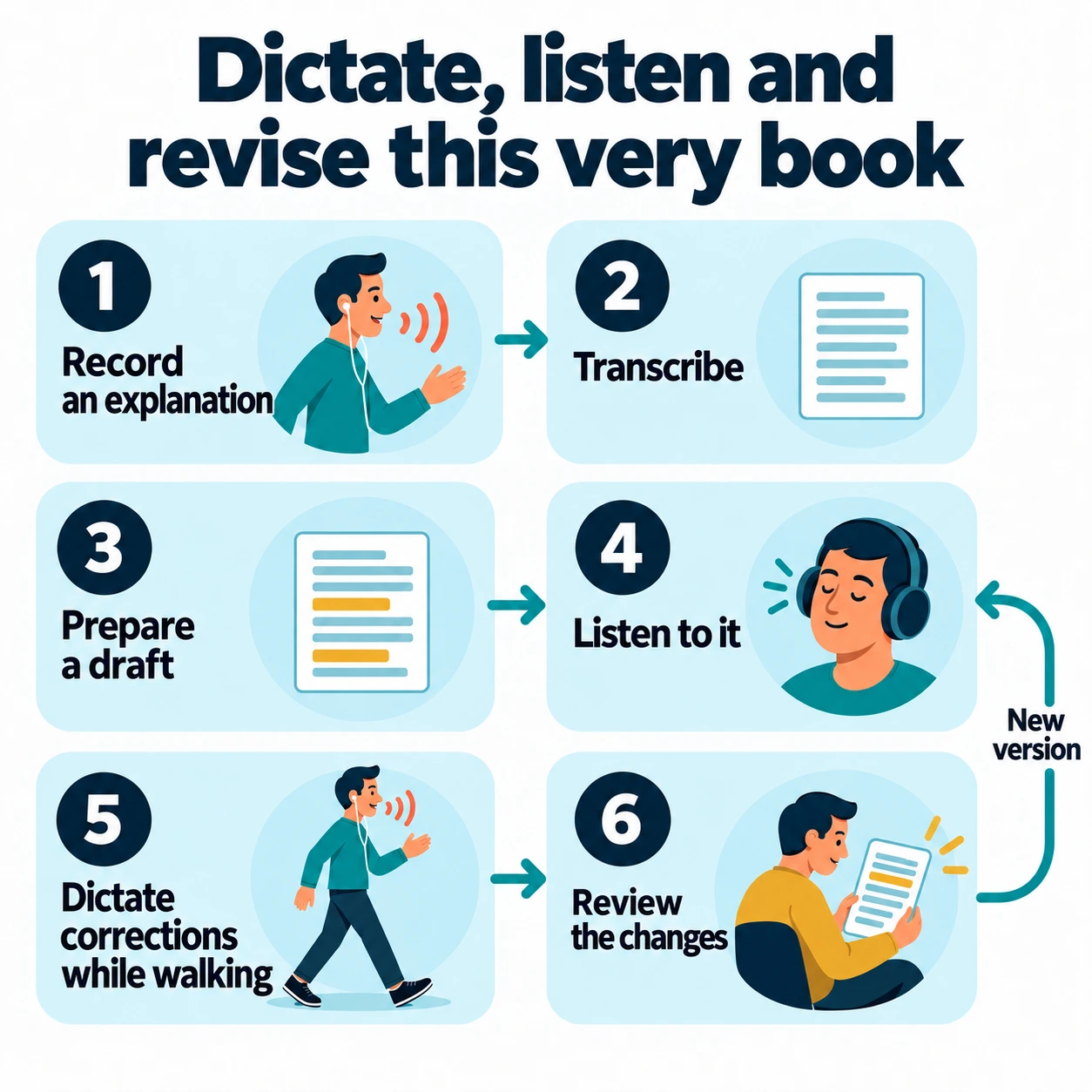
Writing this book is a good example. I use a Plaud device to record my explanations and get a transcript [34]. Then I work on that material with Codex, the AI assistant I use to prepare and review this book, listen to the result as audio, and dictate corrections while I go for a walk. I can exercise, notice that an explanation is too short, and record how I would tell it. When I get back, I add those notes to the project and review the changes. I don’t always have to choose between taking a walk and moving the book forward.
Of course, it costs money, but my time costs money too. Naval Ravikant, an entrepreneur and investor known for his reflections on wealth and happiness, suggests setting a fairly high aspirational hourly rate and delegating tasks that cost less than that amount [2]. It’s an aspiration: it makes me think about where I want to focus my capabilities and how much I’m willing to pay to get my time back. In my case, the device has removed a very specific friction and lets me write while I walk; you’ll have to find the task that’s taking that time away from you.
Another discovery that has been a lifesaver for me is Wispr Flow [34]. I use it to dictate into text fields on my computer: I turn on dictation, explain what I want to write, and the tool prepares the text, even when I correct myself as I speak. When you see how clumsy I am at typing and how many mistakes slip through, you’ll understand why I find it useful. I’m less reluctant now to write an article or an email that explains things properly. Then I check names, figures, and meaning, because a word can be spelled correctly and still be the wrong word.
In class I provoke the students a little: you should all have ChatGPT or an equivalent tool at hand and know how to use its basic features, within your organisation’s rules. It’s quite possible that part of your team is already using one, with or without your knowledge. Not knowing about it doesn’t make the use go away; it just means you know less about how work is changing.
1.3. Understanding where data goes and getting started with automation
One of the first things we look at is data controls. In a personal ChatGPT account, I ask students to find the “Improve the model for everyone” setting and understand what it means to have it turned on or off [4]. If I’m going to enter company information, I need to know how it may be used. A personal account and a tool subscribed to and configured by the company can have different terms.
Business plans offer specific commitments; OpenAI, for example, says it does not use data from its business products to train its models by default [4]. That doesn’t replace the rules about what information we can share. If you need more control, another option is to run models inside your organisation. In that case, check where the data goes: an application can run locally and still have connectors that send information to other services. Ask someone who knows, and give your team a guideline it can follow.
I’m surprised by organisations that prohibit the use of external services and are doing nothing to experiment with internal alternatives. Imagine a programmer who still copies and pastes as they did five years ago, or who uses a personal phone because the company gives them no reasonable option. Perhaps a local model, tested on a specific task, would help a lot. If you’re in charge and don’t understand these possibilities, and have no one looking into them, I think you’re leaving an important responsibility unattended.
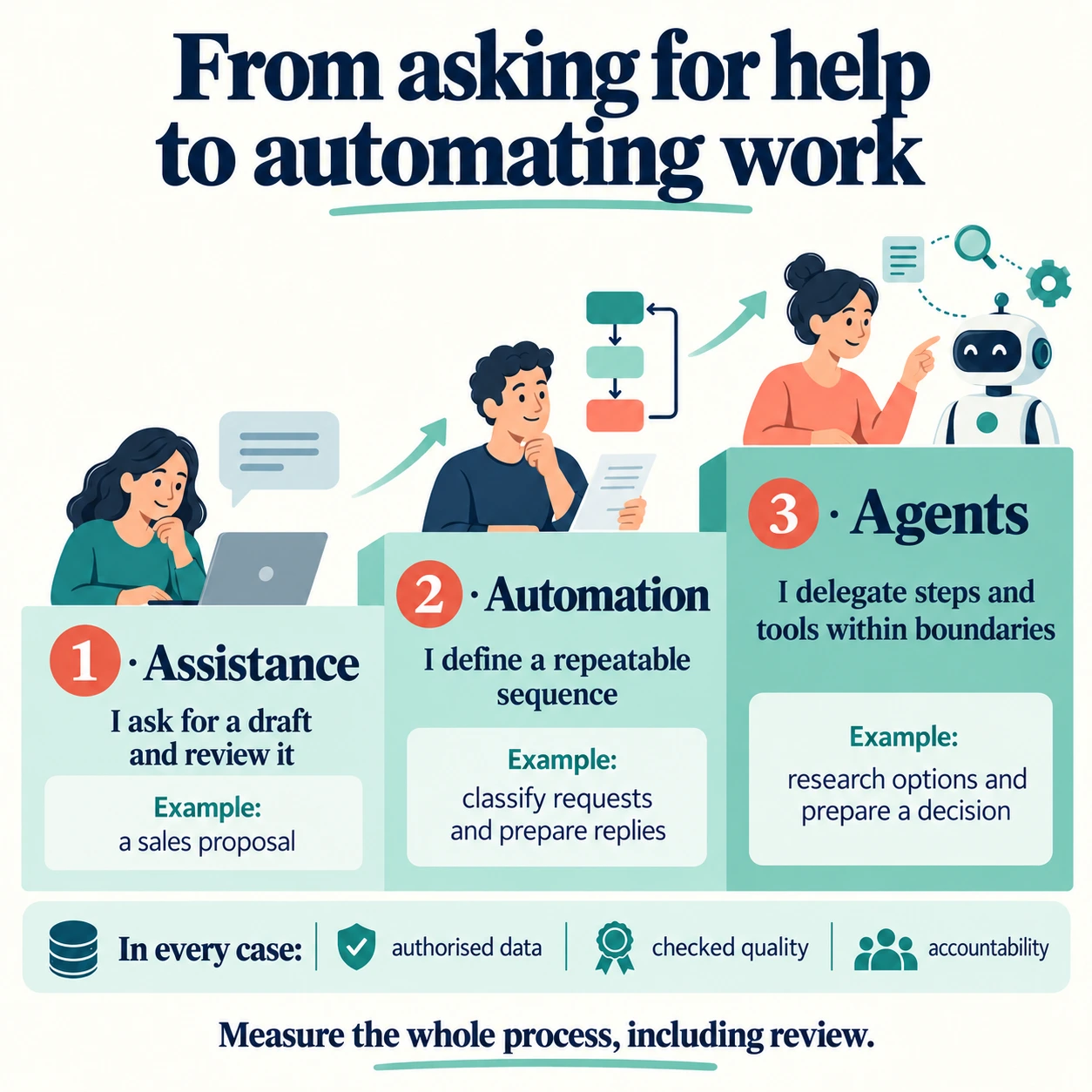
I would distinguish three uses to get the conversation started. First, assistance: I ask for a draft, presentation, or explanation and work from that result. Next, automating a repeated sequence: when a request arrives, classify it, prepare information, and leave a proposal ready for review. Then there are agents that can choose steps and use tools to pursue a goal within set limits. All three forms can coexist. I’ll start with whichever one solves a task that is costing us time today.
To move towards useful automation, I choose a frequent task, measure how long it takes now, define what I consider a correct result, and try an alternative. I count review time and errors too. If an agent can take action, I agree on what it can do on its own and when it needs to stop or ask me to decide. That way I don’t celebrate the tool producing things faster when the work has simply shifted to the person who has to correct it.
We can work with universities. I’d approach professors in industrial engineering or computer science and build a relationship so we can collaborate on undergraduate or master’s theses, or applied research. They need real problems, and we need to explore capabilities we haven’t mastered yet. If I bring together someone with up-to-date knowledge and someone who knows our operations well, both can learn: one understands the business and the other discovers what they might do differently. They need guidance and an agreed scope of work. To build that relationship, I’ll have to free up time or delegate it to someone capable of looking after it; it won’t work if I email a professor and disappear. In fact, if I take tasks off my own plate that others can handle, I can devote part of my schedule to finding these opportunities for the team.
1.4. A logbook that brings back what I want to learn
When I browse X or other social networks, I find articles on AI, psychology, sociology, or management that interest me. They used to end up in a collection of links I never reopened. So I asked my assistant for a skill—a reusable set of instructions—to turn a source into a clear, educational explanation with references and an infographic. That’s how my logbooks began [34]. They aren’t an inventory of what I already know; they capture what I want to learn, prepared in a format that’s easy for me to consume and review. First there’s a curiosity or a need of mine; then I create the material that helps me understand it.
Then I asked for an audio version and a player that would let me listen to entries one after another. Now I can give the assistant a link, say what aspect interests me, review what it prepares, and revisit it while I’m walking, travelling, or going to the gym. I make use of a moment when I might otherwise never return to that content. I listen to get closer to the idea; if I want to learn how to apply it, I go back to the text or try it out.
When my daughter started her entrepreneurship studies, I gave her that same setup. I bought a domain, arranged the hosting, and asked for the instructions to be exported so she could use them with her assistant. She can create her own logbooks at patriciacanales.com [34]. I like that an improvement I’ve already worked on doesn’t have to be reinvented by her.
Imagine doing the same thing within a department. A question someone answers today can become a shared note with its source, an example, and a review date. This collection of external knowledge, connected and retrievable, is often called a second brain, an idea Tiago Forte develops in Building a Second Brain [64]. Accumulating information isn’t enough on its own: we need to know what’s worth keeping, how to find it, and who maintains what changes. For this book, we’ve also prepared a concept map to explore relationships, not just folders.
Andrej Karpathy describes a proposal like this in LLM Wiki: keep the sources and, with help from AI, maintain linked notes that grow richer as you add information and answer questions [41]. I don’t want the work of connecting ideas to disappear when a conversation ends. We have to review those connections and distinguish what the source said from what we’re interpreting.
Iván Carrillo is putting a lot of work into this idea of a Second Brain, both explaining it and building a solution to put it into practice. Here’s a video about his proposal, and if you want to know more, you can visit hardment.com [62]. I’d like you to see different ways to organise knowledge and choose the one that helps you retrieve it, connect it, and share it with your team.
Apply this to a department decision. We chose a supplier because they could deliver in two days, even though another was cheaper. If I only save the supplier’s name, the next person in charge may replace them thinking they’re improving purchasing. If I keep the need, the alternatives, the reason we chose them, and when we should review it, someone else can understand the decision and change it with good judgement. A note about that supplier could be connected to delivery time, the cost of a shutdown, and the quality we need. That looks like knowledge that accumulates to me.
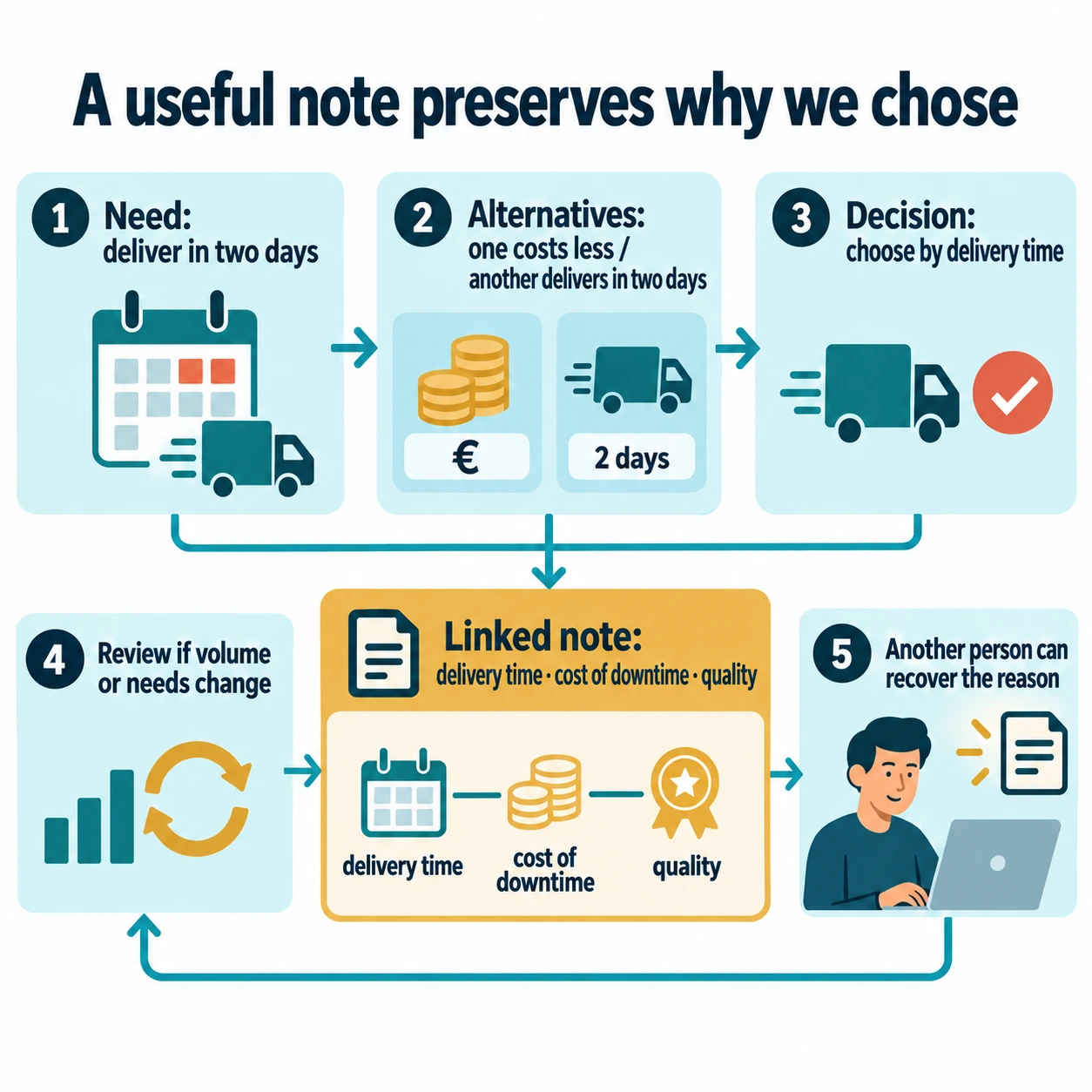
Each connection on the map should let us open the note and understand why it links two things and what decision it helps us make. If it only looks attractive, it still needs work. I also want to find contradictions: perhaps a recommendation that worked for us a year ago no longer fits our current volume. I’d save the earlier decision and the reason for changing it, so the assistant doesn’t turn two criteria from different moments into a confusing answer.
A student asked me whether these tools would reduce the size of teams. I can speak especially about software development: someone defining a product can now prepare much more concrete proposals and prototypes, while integrating, maintaining, and checking what has been built will still require specialists. If I produce faster, I also have to review faster. The same goes for a campaign or a document: speeding up creation shifts work toward definition and validation and, when we connect systems and handle information, cybersecurity. This is security in the sense of protecting systems, access, and data, not safety in the sense of making sure a machine doesn’t injure anyone. We’ll have to watch where the new workload appears.
One study helps sharpen that question. In The Cybernetic Teammate, Dell’Acqua and his coauthors studied professionals at Procter & Gamble working on innovation challenges. In the study published in 2025, the average quality of proposals from people working with AI was comparable to that of proposals from pairs working without AI, and the gap between technical and commercial perspectives narrowed [42]. I find that very interesting, but they were observing one working day, not the months it then takes to see a product through. It encourages me to test which conversations we can prepare better with these tools, not to automatically cut the workforce in half.
In another experiment, published in 2023 and carried out with BCG consultants, using AI improved work on some tasks and reduced accuracy on another that fell outside the model’s capabilities. The authors called this a jagged technological frontier [43]. I’d ask my team to test tasks of our own: summarising a request, preparing alternatives, and checking a conclusion may not work equally well. I’d save one example where it works and another where it fails, along with the check that helps tell them apart. That way we stop arguing about whether “AI is good or bad” and start finding out what we can rely on it for in our work.
We should also save the date of the study and the model used. Technology changes quickly, and a result describes specific conditions: I can’t assume it will still hold two years later, or dismiss it just because a new model has come out. I test again whatever affects our work and update our shared judgement. That review keeps the team from following a recommendation that has gone stale.
I myself spent weeks putting many hours into my master’s project with AI. Being able to define, design, build, and evaluate like a one-person army doesn’t mean I want to do it indefinitely. Once the novelty wears off, I get tired too, and I want other people to carry the work forward. A growing product needs customer service, marketing, support, and the ability to handle several changes at once. That’s why this book’s goal remains to build a culture of self-organising high-performance teams, even as their size and tools change.
1.5. Reading so knowledge can find me again
Imagine that a copy of you writes from five years in the future and tells you what they wish you had started doing today. Perhaps they’ll ask you to take better care of yourself, learn another language, or stop waiting for your company to decide when you get to train in artificial intelligence. What’s interesting about the exercise is that you probably wouldn’t be very surprised by what they said; often we already know what we’re putting off.
There’s no need to turn that conversation into a huge project. If we always frame things as going to the gym every day or doing nothing, earning a degree or never learning, changing the whole company or giving up, we’re making it hard on ourselves. We can set aside some time to walk, read, or explore a tool that might help us at work, and see what changes we can sustain. But we’ll have to make room in our schedules; otherwise, the letter from our future selves will remain fiction.
We can spend hours watching shows, playing games, or scrolling through videos on our phones, and then say we have no time to learn. I’m not going to organise your leisure time, but I am going to ask you to do the maths. If you can find time for everything else but never for your future, you’re making a decision even if you haven’t written it down.
I do some of that updating through reading. I still like physical books, and years ago I stopped worrying about having several on the go: one at home, another in my suitcase, another in the village. I can pick them up whenever I get the chance, because my goal with a management or skills book is to make good use of it. For that, it helps me more to return to some ideas than to finish it very quickly.
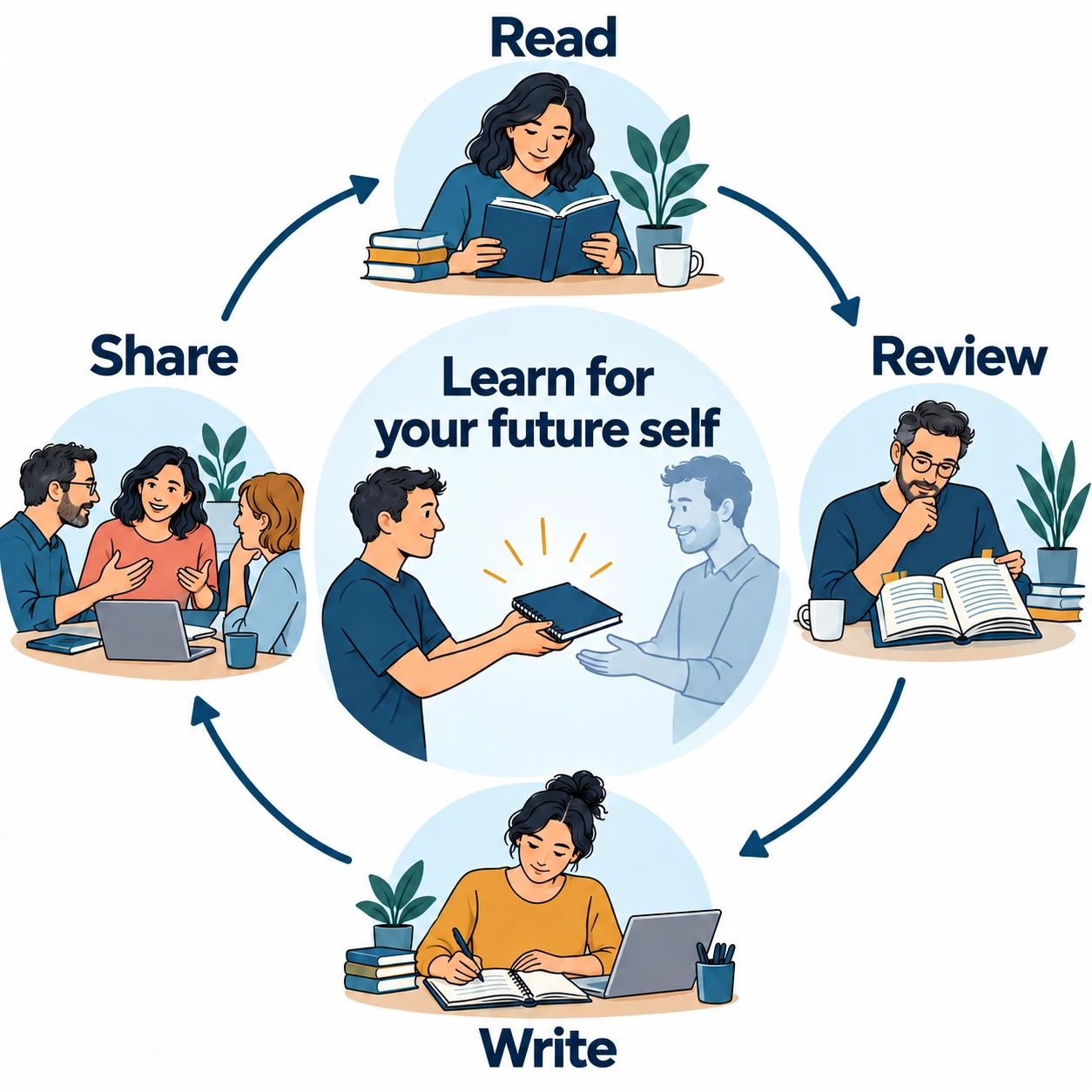
My system is quite simple. I do a quick first read and, when I find something that interests me, I fold down a page corner without marking the exact paragraph. If I stop reading for a while, I leave a different mark so I know where I am. When I finish, I open the folded pages and try to find again what caught my attention; that little effort makes me read and think about it again.
Then I write a summary in my own words and try to give the ideas I’ve chosen some continuity. If I publish it on my website or a professional network, I review it again to make sure it’s clear and fix any mistakes I missed. If someone comments on an idea months later, I return to it. That way, the content I found useful has passed through my mind several times, and I’ve also had to explain it. Now imagine keeping that habit up for years: don’t you think I’m likely to consolidate ideas and find connections between things I used to see as separate? That’s the kind of accumulation I’m after, not a bookshelf proving how fast I read.
I’ve also learnt that the same book can mean different things depending on when you read it. It happened to me with a book that brought together strategy models: the first time, I thought it explained almost nothing. After taking a course, I returned to it and found the diagrams very useful—diagrams I hadn’t known how to interpret before. The book was the same; I had a different context for reading it.
I do something similar with audiobooks and podcasts. They let me get close to a topic while walking or travelling, but listening doesn’t prove that I know how to apply it. If something matters to me, I go back to the text, test it, or try it out. I can also ask AI for an explanation tailored to a specific question; the logbook we just looked at helps me keep that learning from getting lost among hundreds of links.
Having ten years of experience is not the same as repeating the same year ten times. There’s a question I like to ask people who have spent a long time doing the same work: have these years given you different experiences, or have you repeated an experience you already knew many times? In class, I illustrate it with a driver who learns a route and its variations and then repeats it for years. I don’t only want to know how long you’ve been sitting in the job; I want to know what you can do now that you couldn’t do before.
When I share my reading with the team, I also want us to get mentally aligned. If you know which books I’m reading, how I interpret a problem, and what ideas change my mind, it will be easier for you to anticipate my judgement. And if you share yours, you help me too. That conversation builds a way of thinking together that later shows up in our work.
There are a few books I use a lot in class because they help me open conversations we need to have. In The Millionaire Fastlane, M. J. DeMarco describes different ways of relating to money [19]. I tell it with the image of a highway: some people travel on the hard shoulder, some move along in the slow lane, and some try to build a fast lane of their own. On the shoulder, you can spend everything you earn without doing much to prepare for the future; in the slow lane, you can rely on your salary, savings, and a long journey; in the fast lane, you try to build something whose results can grow beyond your hours. I like the image because it makes you look at the vehicle you’ve chosen, not just how eagerly you press the accelerator.
If all you can sell is one hour of your time, there are only so many hours available. You can charge more for them, and that is a change, but you need to understand where the next leap will come from. In the next chapter, we’ll look at this through Naval, people, capital, and products. What I don’t want is for you to confuse doing many things with having chosen a model that brings you closer to what you want.
In Polymath, by Peter Hollins, I find another conversation we need to have: how much it makes sense for us to learn outside our speciality [20]. A T-shaped profile combines a vertical bar of deep expertise with a horizontal bar of knowledge that lets you talk with others. If I know a lot about technology but don’t understand how something is sold, how an investment is financed, or what concerns a people manager, I’ll need too much translation in too many meetings. I can keep widening that shape, develop two specialities like the letter pi, or several like the teeth of a comb. I don’t need to know everything; I need to stop treating everything outside my profession as none of my business.
Blitzscaling, by Reid Hoffman and Chris Yeh, helps me explain why a growing company needs to change how it works [21]. Hoffman uses the image of moving from pirate to navy. I explain it this way: you don’t lead a boat the same way you lead a fleet, and you can’t always behave like the pirate captain who was in every battle. At some point, you need to act more like an admiral: coordinate, choose people to take responsibility, and get different ships moving with a shared purpose. If the company changes size and you keep giving orders in exactly the same way, you may become the problem that keeps it from working.
Solving complex problems has a lot to do with connecting these perspectives. The World Economic Forum’s The Future of Jobs Report 2025 highlights analytical, creative, and systems thinking among the capabilities that matter at work [22]. I’m interested in the practical implication: whenever a problem crosses several departments, an answer from just one speciality falls short. Reading outside your field lets you ask questions that wouldn’t have occurred to you before.
And if I could read only one book in my life, I’d read The Almanack of Naval Ravikant, compiled by Eric Jorgenson [2]. I’ve recommended it to my daughter too because it brings together ideas about wealth, judgement, learning, and life that have given me a lot to think about, even if not every page has to fit you. In the next chapter, I’ll pause over some of those ideas and connect them to my experience in business.
As we agreed at the beginning, one person can find each reference and share it. The interesting work comes afterwards: choose an idea from the book and explain how it changes a decision our team makes. The most important thing about a book isn’t finishing it quickly; it’s getting the most out of it.
There’s a saying that sums up quite well why I like this activity: “If you want to go fast, go alone; if you want to go far, go together” [24]. I want us to keep each other company as we learn, too. When someone comes back months later to one of my posts and comments on an idea, knowledge finds me again; that person helps me remember something I had already worked on and may not have used for a while.